Implementation of FPGA-Based High-Speed Image Processing Architecture for Real-Time Applications
Keywords:
Abstract
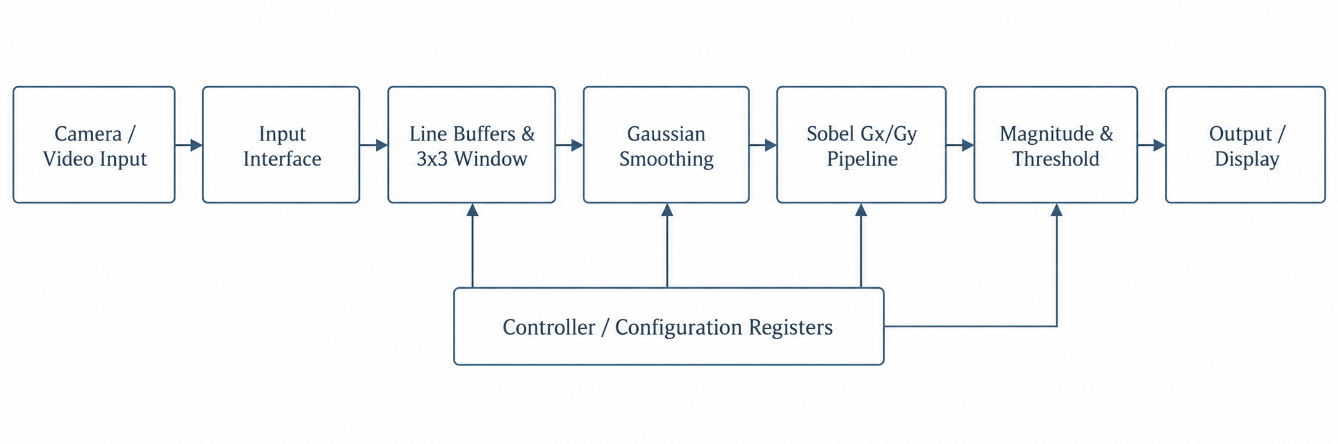
Field-programmable gate arrays (FPGAs) are well suited to real-time image processing because spatial parallelism, pipelining, deterministic latency, and distributed on-chip memory can be tailored to the regular data flow of image operators. This methodology paper presents a high-speed streaming architecture for real-time applications in which pixels are accepted at one sample per clock after pipeline fill. The proposed design combines an input interface, line-buffered 3×3 neighborhood generator, Gaussian smoothing, Sobel gradient computation, magnitude approximation, thresholding, and a configurable output stage. The methodology emphasizes fixed-point arithmetic, local pixel reuse, balanced pipeline stages, and elimination of unnecessary frame-buffer transfers. A design target of 150 MHz is adopted for analytical evaluation. At one pixel per clock, the architecture has a nominal capacity of 150 million pixels/s, corresponding to about 162.8 frames/s for 1280×720 images and 72.3 frames/s for 1920×1080 images, excluding video blanking and interface overhead. The calculated minimum active-pixel clock for 1080p at 60 frames/s is 124.416 MHz. These results show that a deeply pipelined FPGA datapath can satisfy common high-definition real-time constraints while retaining reconfigurability. The study is intentionally methodological: performance values for the proposed architecture are analytical design estimates rather than claims from a fabricated or place-and-route-tested prototype.