
HALE-Net: An Attention-Gated Heterogeneous Ensemble of Convolutional and Transformer Networks for High-Precision Biomedical Image Classification
DOI:
https://doi.org/10.65521/ijacect.v15i2.3918Keywords:
Abstract
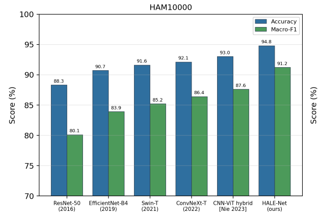
Automated interpretation of biomedical images is limited by high inter-class similarity, severe class imbalance, and the divergent inductive biases of individual deep networks, which cause single-architecture classifiers to generalise inconsistently across imaging modalities. This work introduces HALE-Net, a heterogeneous attention-gated learner ensemble for high-precision biomedical image diagnosis. The objectives are threefold: to exploit the complementary representational strengths of convolutional, transformer, and hybrid backbones; to fuse them through a confidence-aware mechanism that suppresses unreliable predictions; and to preserve deployability on resource-limited clinical hardware. Three base learners—ConvNeXt-T, Swin-T, and a compact convolution–attention hybrid (ConvFormer)—are trained under a class-balanced focal objective and combined by an attention-gated stacking meta-learner that weights each learner per sample according to its calibrated posterior and predictive entropy. Computational cost is contained through depthwise-separable convolutions, a confidence-triggered early-exit path, and knowledge distillation of the ensemble into a 6.2 M-parameter student (HALE-S). On two public benchmarks—HAM10000 (10,015 dermoscopic images, seven classes) and BUSI (780 breast-ultrasound images, three classes)—HALE-Net attains 94.8% accuracy, 0.912 macro-F1 and 0.991 AUC on HAM10000, and 97.9% accuracy, 0.972 macro-F1 and 0.995 AUC on BUSI, improving over the strongest single backbone by 2.0–2.7 percentage points in macro-F1. The distilled student retains 93.9% accuracy at one-eleventh of the parameters and a 7.3 ms latency, while early-exit lowers the mean cost of the full model by approximately 45%. The findings indicate that calibrated heterogeneous fusion, rather than deeper individual networks, is an effective route to dependable diagnosis, with direct relevance to point-of-care dermatological screening, breast-cancer triage, and other real-time computer-aided diagnosis settings.
Downloads
Published
How to Cite
Issue
Section
License

This work is licensed under a Creative Commons Attribution-NoDerivatives 4.0 International License.
