Lightweight Cryptographic Framework with Graph Intelligence for Energy-Efficient MANET Protection
Keywords:
Abstract
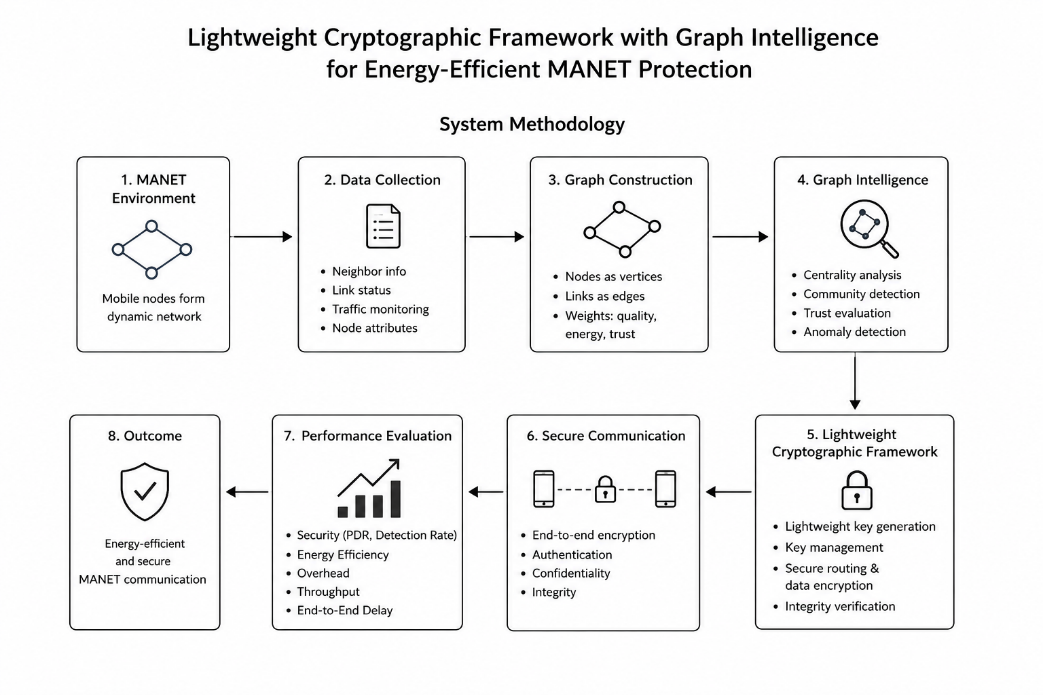
Mobile Ad Hoc Networks (MANETs) have emerged as highly dynamic and decentralized wireless communication systems capable of supporting military operations, disaster recovery, emergency response environments, intelligent transportation systems, healthcare monitoring, and Internet of Things (IoT) applications without relying on fixed communication infrastructure. However, MANETs are highly vulnerable to security threats due to their open wireless communication medium, distributed architecture, limited computational resources, dynamic topology, and absence of centralized management. Traditional cryptographic security mechanisms often introduce high computational overhead, excessive energy consumption, communication latency, and routing complexity, making them unsuitable for resource-constrained MANET environments. Furthermore, conventional intrusion detection systems frequently experience scalability limitations and insufficient adaptability to dynamic routing attacks such as black hole attacks, packet interception, and malicious routing manipulation. To address these challenges, this research proposes a Lightweight Cryptographic Framework with Graph Intelligence for Energy-Efficient MANET Protection that integrates lightweight cryptographic algorithms, graph-based security intelligence, adaptive trust evaluation, energy-aware secure routing, and intelligent anomaly detection into a unified MANET security architecture. The proposed framework utilizes lightweight symmetric encryption, elliptic curve cryptography, hash-based authentication, and graph neural intelligence to provide secure communication, confidentiality, integrity, and adaptive malicious node detection while minimizing computational overhead and energy consumption.