A Comprehensive Review of an Efficient Cascaded Deep Capsule Cell Attention Network Model for Breast Cancer Molecular Subtypes Prediction Using Mammogram Images
DOI:
https://doi.org/10.65521/ijacect.v14i2.2750Keywords:
Abstract
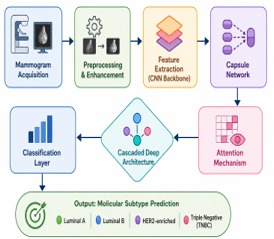
Breast cancer remains one of the leading causes of mortality among women worldwide, with molecular subtypes such as Luminal A, Luminal B, HER2-enriched, and triple-negative playing a critical role in treatment planning and prognosis. Accurate prediction of these subtypes traditionally requires invasive biopsy procedures. Recently, deep learning-based approaches using mammogram images have emerged as a promising non-invasive alternative. This review presents a comprehensive analysis of advanced architectures for breast cancer molecular subtype prediction, with a particular focus on cascaded deep capsule networks integrated with attention mechanisms. Convolutional Neural Networks (CNNs), transfer learning models, and hybrid architectures have demonstrated strong performance in mammography-based diagnosis. Capsule networks (CapsNets), with their ability to preserve spatial hierarchies and part–whole relationships, offer improved feature representation compared to traditional CNNs. Furthermore, attention mechanisms enhance the model’s ability to focus on relevant regions, improving classification accuracy. Cascaded architectures combining CNNs, CapsNets, and attention modules have shown significant potential in capturing both local and global features for subtype prediction. This review highlights recent advancements, compares state-of-the-art models, and discusses key challenges such as data scarcity, model interpretability, and computational complexity. The findings indicate that integrating capsule networks with attention mechanisms in a cascaded framework significantly improves performance in molecular subtype prediction. Future research should focus on multimodal learning, explainable AI, and lightweight architectures for real-time clinical deployment.