Study of Magnetic and Electrical Properties of Transition Metal Oxide Thin Films
DOI:
https://doi.org/10.65521/apl.v8i1.4271Keywords:
Abstract
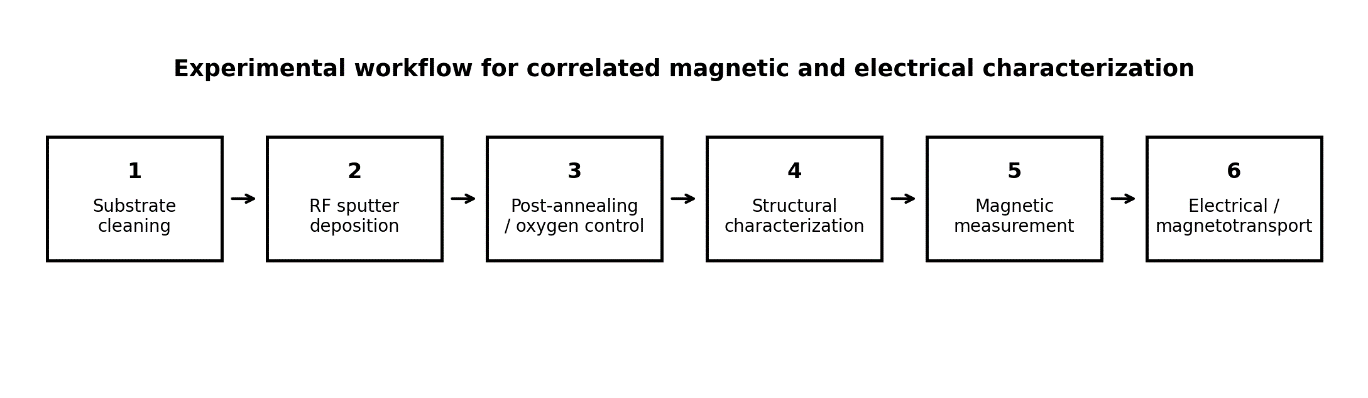
Transition metal oxide (TMO) thin films exhibit strongly coupled charge, spin, orbital, lattice, and defect degrees of freedom, enabling electrical and magnetic responses that can be engineered by composition, strain, oxygen stoichiometry, thickness, and processing conditions. This methodology paper presents a compact experimental framework for studying representative NiO, iron-oxide, and La0.7Sr0.3MnO3 (LSMO) thin films deposited by radio-frequency magnetron sputtering and subsequently optimized by controlled annealing. The workflow integrates X-ray diffraction and surface characterization with vibrating-sample magnetometry, four-point-probe/Hall measurements, temperature-dependent resistivity, and magnetoresistance. The approach is designed to correlate crystalline phase and defect structure with saturation magnetization, coercivity, carrier transport, resistivity, metal-insulator behavior, and field-dependent electrical response. Literature up to 2019 demonstrates that oxygen pressure, epitaxial strain, preferred orientation, film thickness, and interface quality can substantially alter the transport and magnetic states of oxide films. The results section therefore provides literature-consistent, illustrative values to demonstrate the proposed analysis; these values are not presented as newly measured laboratory data. The methodology offers a reproducible route for screening TMO thin films for magnetic sensors, spintronic elements, resistive devices, and oxide-electronic applications.