Computational Analysis of Heat Transfer in Two-Dimensional Physical Systems
DOI:
https://doi.org/10.65521/apl.v4i1.4194Keywords:
Abstract
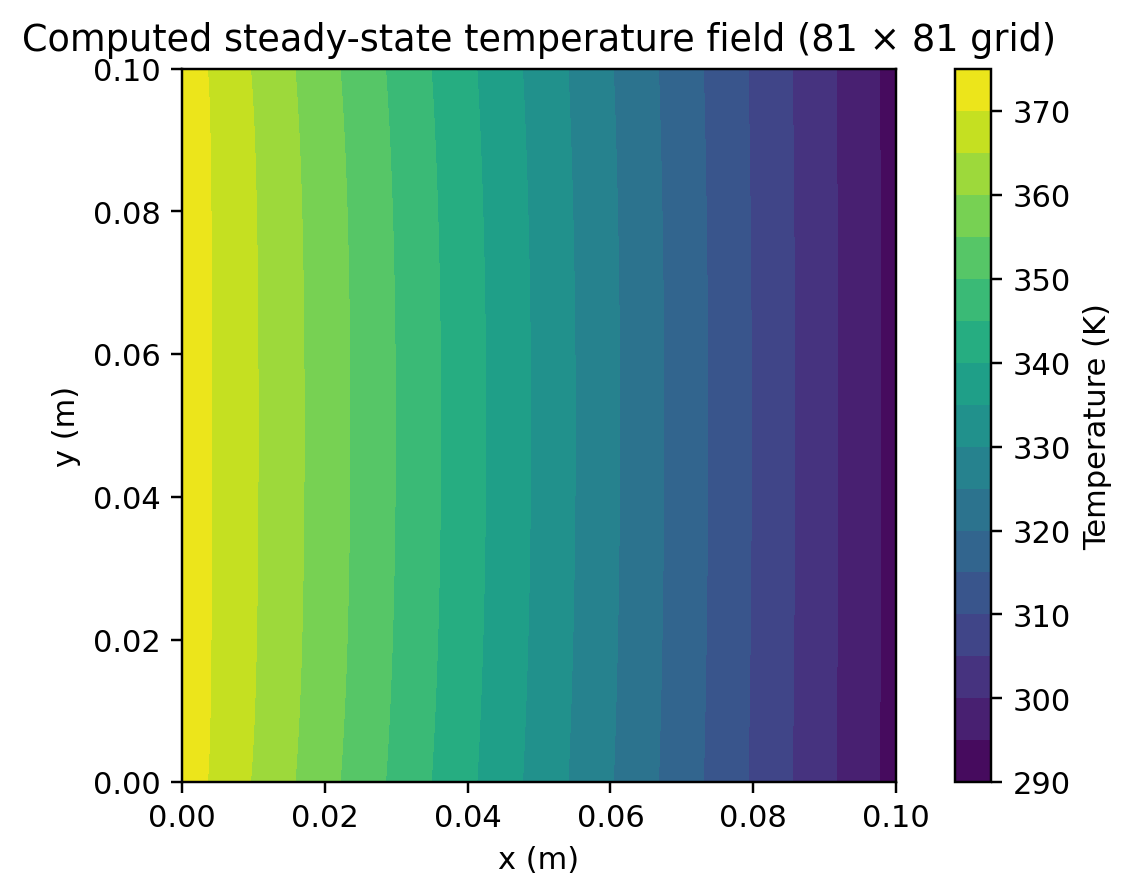
This methodology paper presents a computational framework for analyzing two-dimensional heat transfer in physical systems using a finite-difference formulation. A square isotropic solid with uniform internal heat generation is selected as a reproducible benchmark because it combines prescribed-temperature and convective boundary conditions and produces a genuinely two-dimensional temperature field. The steady heat-conduction equation is discretized on a structured Cartesian grid using second-order central differences. Dirichlet conditions are imposed at the left and right boundaries, while Robin convection conditions are introduced at the upper and lower boundaries by a ghost-node elimination procedure. The resulting sparse algebraic system is solved directly, and the computational solution is assessed through grid refinement and an overall energy-balance check. For the adopted benchmark, the center temperature converges to approximately 334.056 K, and refinement from 41×41 to 81×81 nodes change the center temperature by less than 0.001%. The net boundary heat-flow imbalance on the 81×81 grid is approximately 0.5% of the prescribed volumetric heat generation, supporting numerical consistency. The study demonstrates a transparent workflow for geometry definition, governing-equation formulation, discretization, solution, verification, and post-processing. The approach is suitable as a baseline for more complicated two-dimensional conduction, conjugate heat-transfer, and enclosure-flow problems. All literature cited in the methodological development was published in or before 2015.