
Personalized Food Risk Assessment Using Ingredient-Level Machine Learning: Design and Preliminary Analysis
Keywords:
Abstract
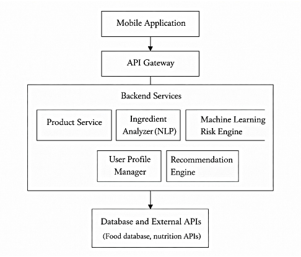
Anyone who has tried to eat healthily knows how confusing food labels can be. Ingredient lists often look more like laboratory reports than practical information, and for people with diabetes, allergies, thyroid conditions, or other health concerns, that confusion can become a real risk. This motivated us to develop a system that reads food labels more like a nutritionist would, identifying important ingredients and adjusting their risk according to the person consuming the product. The system works in three connected stages. Optical Character Recognition extracts text directly from the food label, removing the need for manual entry. Natural Language Processing then cleans and standardizes inconsistent ingredient names, abbreviations, and spelling variations. Finally, a machine learning model analyzes the processed ingredients and assigns risk scores based on patterns learned during training. The key difference is personalization. Instead of giving every user the same warning, the system considers medical conditions, allergies, and dietary preferences when evaluating ingredient risk. Tested on roughly 800 packaged food products, XGBoost achieved 91.4% classification accuracy with personalization features. The goal is not simply high accuracy, but to turn complex food-label information into a clear, personal, and actionable answer that helps consumers make safer choices.
Downloads
Published
How to Cite
Issue
Section
License

This work is licensed under a Creative Commons Attribution-NoDerivatives 4.0 International License.
