
A Hybrid Framework for Hallucination Detection & Mitigation in Large Language Models
Keywords:
Abstract
Large Language Models (LLMs) have achieved significant breakthroughs in natural language processing, enabling advanced capabilities in text generation, reasoning, and conversational intelligence. However, a critical limitation persists in the form of hallucinations, where models generate factually incorrect or unverifiable information while maintaining high linguistic confidence. This issue poses substantial risks in high-stakes applications such as healthcare decision support, legal advisory systems, and educational platforms, where accuracy and reliability are paramount. Existing approaches primarily focus on model scaling or fine-tuning, yet they often lack robust mechanisms for real-time verification and interpretability. Addressing this challenge requires a systematic framework capable of detecting, quantifying, and mitigating hallucinated outputs while preserving response fluency and contextual relevance.
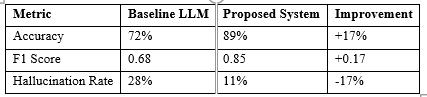
This paper proposes a hybrid hallucination detection and mitigation framework that integrates Retrieval-Augmented Generation (RAG), semantic similarity analysis, and a multi-factor confidence scoring mechanism. The system leverages external knowledge sources through vector-based retrieval to validate generated responses and employs transformer-based embeddings to measure semantic consistency between model outputs and verified evidence. A classification layer identifies hallucinated content, followed by a mitigation module that refines responses using grounded contextual information. Experimental evaluation on benchmark datasets such as TruthfulQA and FEVER demonstrates a substantial reduction in hallucination rates and a marked improvement in factual accuracy compared to baseline LLMs. The proposed approach enhances the trustworthiness, explainability, and practical applicability of AI systems, providing a scalable solution for deploying reliable language models in real-world environments.
Downloads
Published
How to Cite
Issue
Section
License

This work is licensed under a Creative Commons Attribution-NoDerivatives 4.0 International License.
