
MRI
MRI India Journals Vol. 13 No. 2S (2026): Special Issue: ICSAIEM

AI Hallucinations and Observability: A Unified Framework for Detection, Mitigation, and Self-Aware AI Systems

Authors

  • Vishwanath Patre Department of Artificial Intelligence and Data Science, Dr. D. Y. Patil College of Engineering and Innovation, Pune, India.
  • Roanak Singh Department of Artificial Intelligence and Data Science, Dr. D. Y. Patil College of Engineering and Innovation, Pune, India.
  • Hardik Jain Department of Artificial Intelligence and Data Science, Dr. D. Y. Patil College of Engineering and Innovation, Pune, India.
  • Yash Bhor Department of Artificial Intelligence and Data Science, Dr. D. Y. Patil College of Engineering and Innovation, Pune, India.
  • Farendrakumar Ghodichor Department of Artificial Intelligence and Data Science, Dr. D. Y. Patil College of Engineering and Innovation, Pune, India.

Keywords:

AI Hallucination Observability Large Language Models Detection Mitigation

Abstract

Artificial Intelligence systems, especially Large Lan- guage Models (LLMs), have shown rapid progress in generating and understanding human language. Despite these advancements, hallucination—where models produce incorrect or unsupported information—remains a critical challenge. Existing solutions often focus on individual aspects such as detection or correction, but lack an integrated approach.

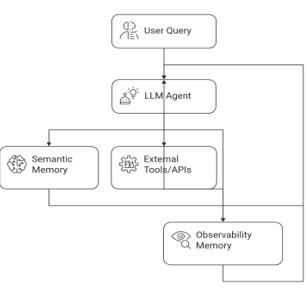
This paper proposes a unified observability-driven framework that integrates memory systems, generalization boundary de- tection, cross-model validation, and continuous monitoring. The proposed system enables AI to become self-aware by learning from past behavior and identifying its knowledge limits. The framework improves reliability, reasoning consistency, and trust- worthiness of AI systems.
Downloads

Published

2026-07-11

How to Cite

Patre, V., Singh, R., Jain, H., Bhor, Y., & Ghodichor, F. (2026). AI Hallucinations and Observability: A Unified Framework for Detection, Mitigation, and Self-Aware AI Systems. Multidisciplinary Journal of Research in Engineering and Technology, 13(2S), 371–377. Retrieved from https://journals.mriindia.com/index.php/mjret/article/view/4048

Similar Articles

<< < 3 4 5 6 7 8 9 10 11 12 > >> 

You may also start an advanced similarity search for this article.
