
AI Carbon Footprint: Measurement and Optimization for Green AI System
Keywords:
Artificial Intelligence
Green AI
Carbon Footprint
Energy Efficiency
Sustainable Computing
Machine Learning
Emission Measurement
Model Optimization
Deep Learning
Environmental Impact
CodeCarbon
CO₂ Emissions
Abstract
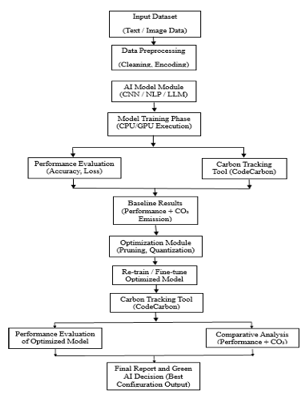
Industries have been revolutionized by artificial intelligence (AI), yet the energy and carbon emissions involved in training, fine-tuning, and serving AI models are increasing quickly. The methodical approach to measuring AI carbon footprints, designing optimization techniques, and implementing a Green AI system that reduces energy use without sacrificing performance is presented in this work. To demonstrate increased efficiency, we present an end-to-end framework, an algorithmic optimization model, and an experimental comparison with current methods.
Downloads
Published
2026-07-05
How to Cite
Patel, U. R., Bole, I. N., Newase, S. V., Shaikh, D. S. A. G., & Ghodichor, F. (2026). AI Carbon Footprint: Measurement and Optimization for Green AI System. Multidisciplinary Journal of Research in Engineering and Technology, 13(2S), 292–297. Retrieved from https://journals.mriindia.com/index.php/mjret/article/view/4028
Issue
Section
Articles
License

This work is licensed under a Creative Commons Attribution-NoDerivatives 4.0 International License.
