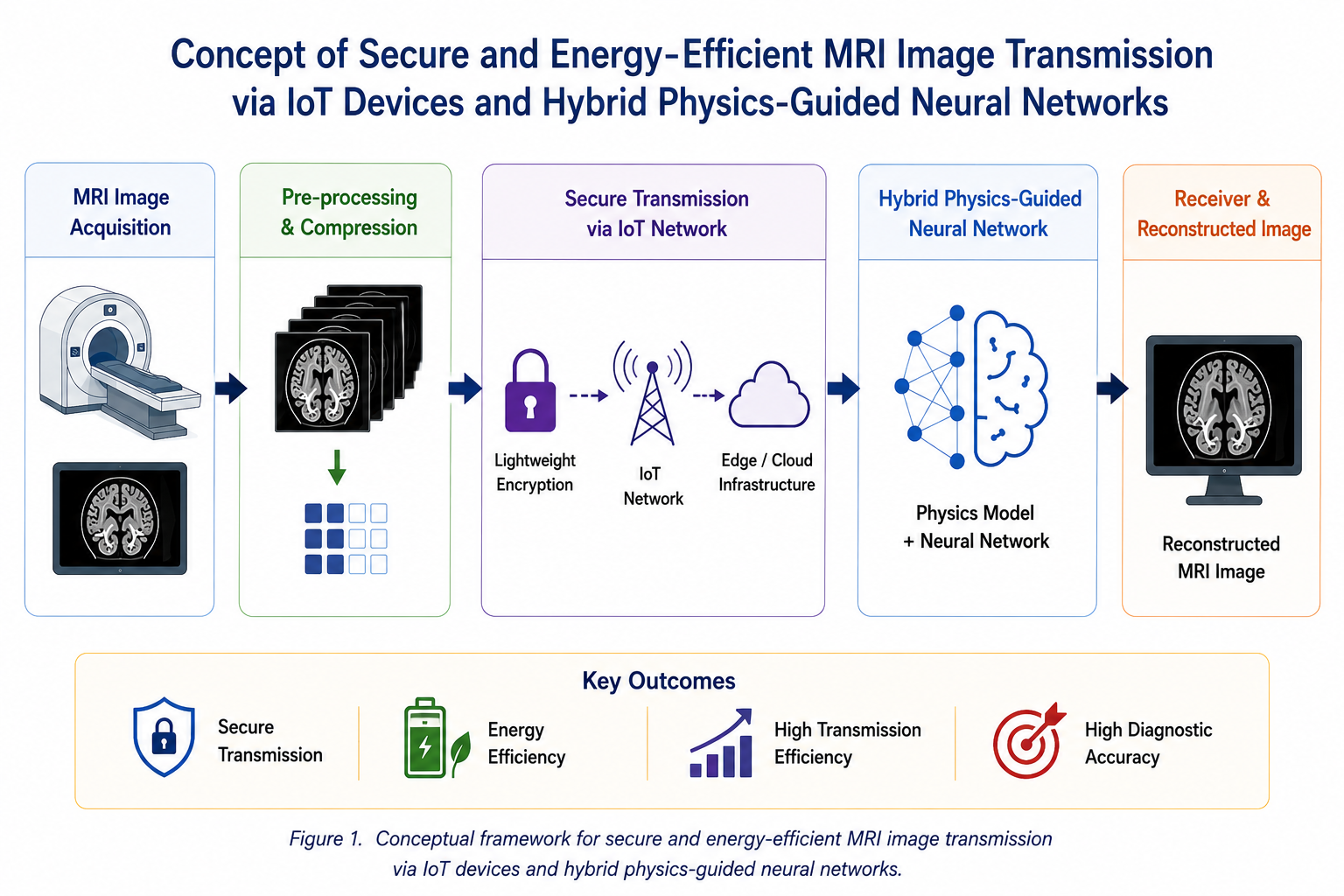
A Survey of Methods and Architectures for Secure and Energy-Efficient MRI Image Transmission via IoT Devices and Hybrid Physics-Guided Neural Networks
Keywords:
Abstract
The rapid growth of the Internet of Things (IoT) in healthcare has significantly transformed medical imaging systems, particularly in the secure transmission of Magnetic Resonance Imaging (MRI) data. However, the transmission of MRI images over IoT networks presents critical challenges related to data security, privacy preservation, and energy efficiency. This survey paper explores recent methods and architectures developed for secure and energy-efficient MRI image transmission, emphasizing the integration of hybrid physics-guided neural networks. The study reviews encryption techniques such as chaotic systems, DNA-based cryptography, compressed sensing, and lightweight cryptographic algorithms tailored for resource-constrained IoT environments. Furthermore, the role of artificial intelligence, including deep learning and hybrid neural architectures, is analysed in improving both transmission efficiency and diagnostic accuracy. Emerging paradigms such as edge computing, fog computing, blockchain, and federated learning are also examined for their ability to enhance security and reduce energy consumption. Comparative analysis highlights trade-offs between computational complexity, security strength, and transmission efficiency. The survey concludes that hybrid approaches combining AI, lightweight encryption, and distributed architectures provide the most promising solutions for next-generation healthcare systems.