Artificial Intelligence Techniques for Resource Allocation via Sparsity-Aware Orthogonal Initialization of Deep Neural Networks in Free Space Optical Communications: Trends and Challenges
Keywords:
Abstract
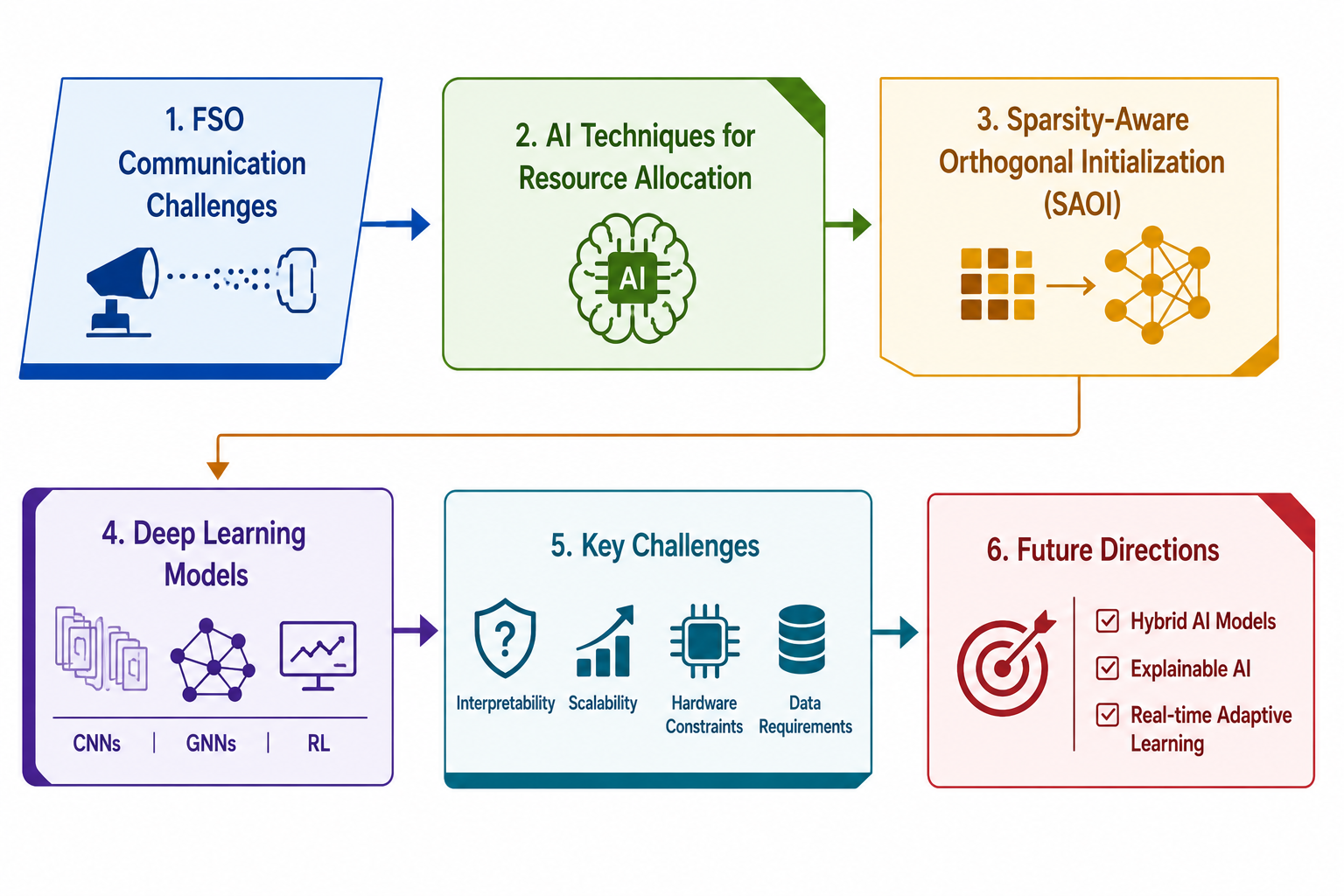
Free Space Optical (FSO) communication has emerged as a promising high-capacity wireless communication technology due to its large bandwidth, low latency, and immunity to electromagnetic interference. However, FSO systems are highly susceptible to atmospheric turbulence, pointing errors, and channel fading, which significantly degrade system performance. To address these challenges, Artificial Intelligence (AI) techniques, particularly deep learning-based models, have been widely explored for resource allocation, channel estimation, and adaptive optimization in FSO networks. Among these, sparsity-aware orthogonal initialization (SAOI) of deep neural networks has gained attention for improving training efficiency, reducing computational complexity, and enhancing convergence stability in large-scale neural models. This paper presents a comprehensive review of AI-based resource allocation techniques in FSO communication systems, focusing on sparsity-aware orthogonal initialization methods. The study highlights how SAOI improves gradient flow and enables efficient training of deep and sparse neural architectures, making them suitable for real-time and energy-constrained FSO environments. Furthermore, recent advancements in deep learning approaches such as convolutional neural networks (CNNs), graph neural networks (GNNs), and reinforcement learning-based optimization are analysed for their effectiveness in handling dynamic FSO channel conditions. The review also identifies critical challenges, including model interpretability, scalability, hardware implementation constraints, and the need for large annotated datasets. Future research directions emphasize hybrid AI models, explainable AI, and real-time adaptive learning frameworks. Overall, this paper provides valuable insights into the integration of advanced AI techniques with FSO communication systems for improved resource allocation and system performance.