Recent Advances in IoT and Wireless Sensor Network-Based Three-Tier Architecture for Continuous Cardiac Health Monitoring and Alert System Using Spatio-Temporal Graph Convolutional Neural Network: A Systematic Review
Keywords:
Abstract
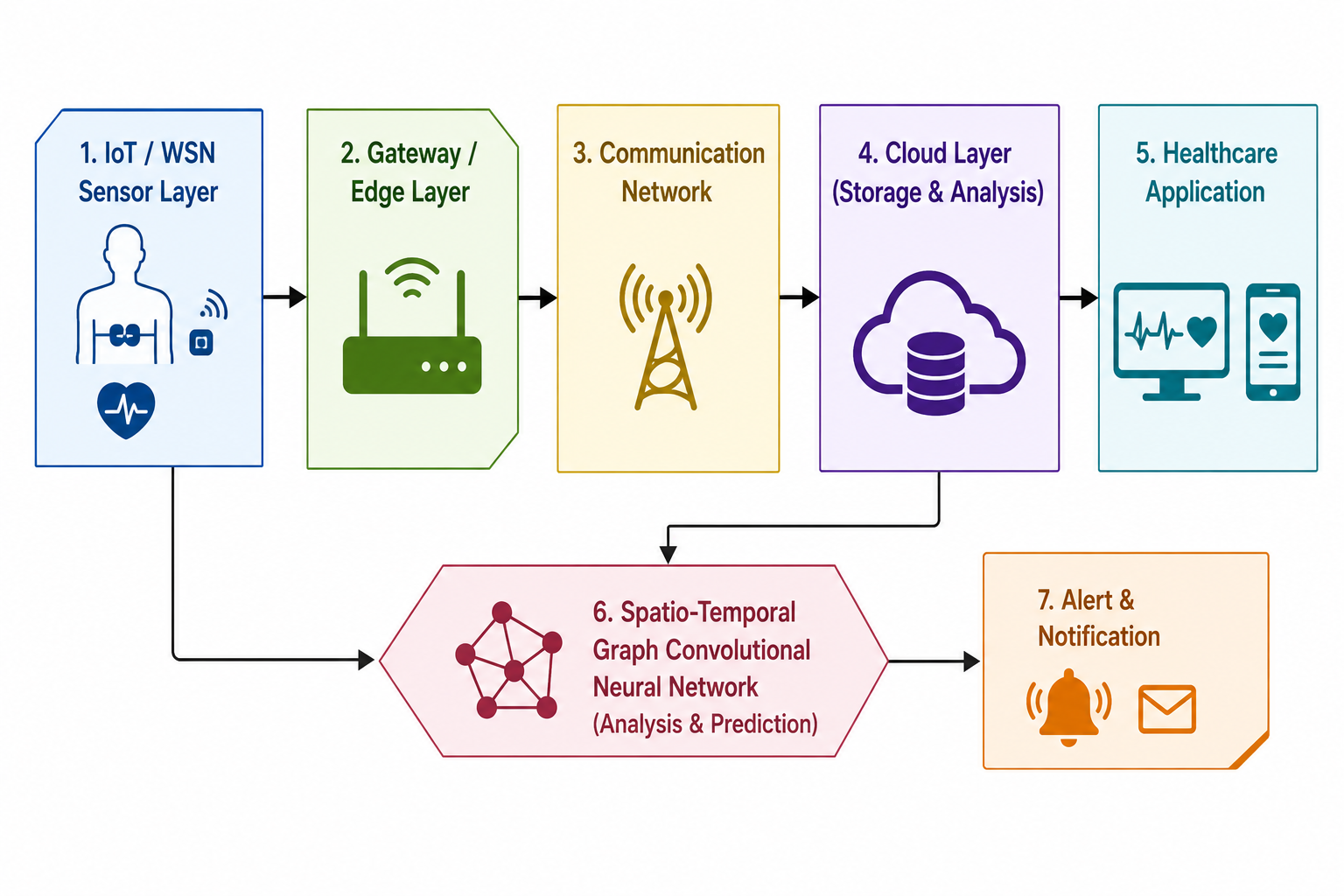
The rapid advancement of Internet of Things (IoT) and Wireless Sensor Networks (WSNs) has significantly transformed modern healthcare systems, particularly in continuous cardiac health monitoring. Cardiovascular diseases remain one of the leading causes of mortality worldwide, necessitating real-time, accurate, and scalable monitoring solutions. IoT-enabled healthcare systems integrate wearable sensors, communication networks, and cloud computing to facilitate remote patient monitoring and timely medical intervention. This study presents a systematic review of recent advancements in IoT and WSN-based three-tier architectures for continuous cardiac health monitoring systems. The three-tier architecture typically consists of sensor nodes (data acquisition), gateway or edge layer (data processing), and cloud layer (data storage and analysis). Furthermore, the integration of Spatio-Temporal Graph Convolutional Networks (ST-GCNs) has enhanced the capability of healthcare systems to model temporal and spatial dependencies in physiological data, enabling improved prediction and anomaly detection in cardiac signals. These models provide superior performance in analysing ECG and heart rate variability data compared to traditional machine learning approaches. The review highlights key methodologies, architectures, and optimization strategies, while also identifying challenges such as data privacy, energy efficiency, and computational complexity. The findings suggest that the convergence of IoT, WSNs, and graph-based deep learning offers a promising direction for developing intelligent, scalable, and energy-efficient cardiac monitoring systems.