A Survey of Methods and Architectures for Deep Recursive Self-Attention Modules: MANET-Based Integrated Sensor System for Disaster Detection and Communication in Hazardous Environments
Keywords:
Abstract
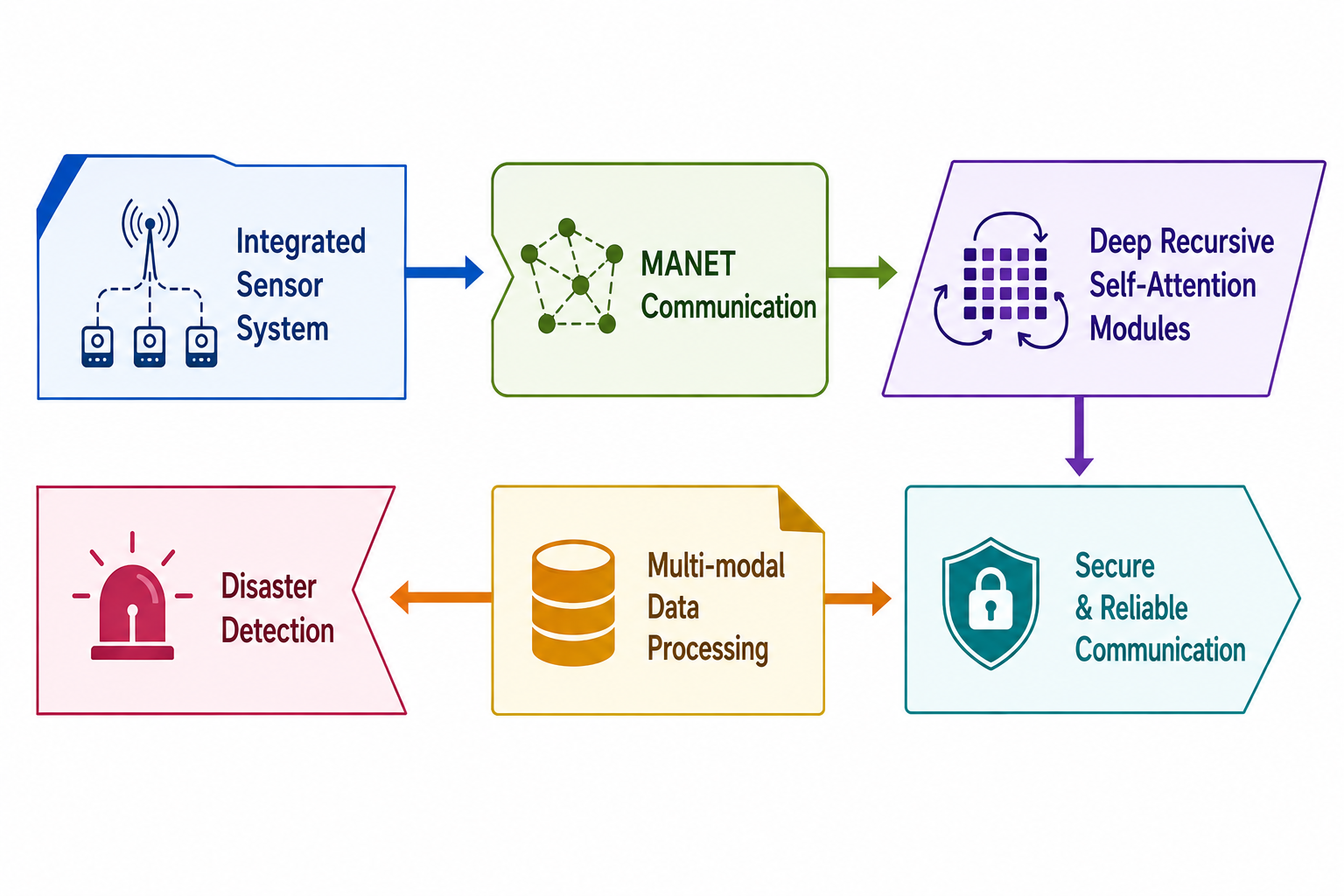
Disaster detection and communication in hazardous environments require intelligent, decentralized, and real-time systems capable of handling dynamic conditions and heterogeneous data sources. Mobile Ad Hoc Networks (MANETs), combined with integrated sensor systems, provide a robust infrastructure-less communication framework for disaster management. Recent advances in deep learning, particularly deep recursive self-attention modules, have significantly improved the efficiency of such systems by enabling adaptive feature extraction and contextual learning. Attention mechanisms enhance model performance by focusing on critical data patterns and capturing long-range dependencies, which are essential for processing multi-modal sensor data and disaster imagery. Recent studies demonstrate that hybrid deep learning architectures integrating convolutional neural networks (CNNs) with attention mechanisms improve detection accuracy and feature representation in complex environments. Additionally, multi-attention network (MANet) architectures have shown superior performance in extracting contextual dependencies and improving semantic understanding in large-scale datasets. Deep learning-based MANET systems also enhance network security and anomaly detection using autoencoder-based models and hybrid CNN-LSTM architectures. This survey provides a comprehensive review of methods and architectures integrating deep recursive self-attention modules with MANET-based sensor systems for disaster detection and communication. It highlights key advancements, comparative insights, challenges, and future research directions for developing intelligent, scalable, and resilient disaster management systems.