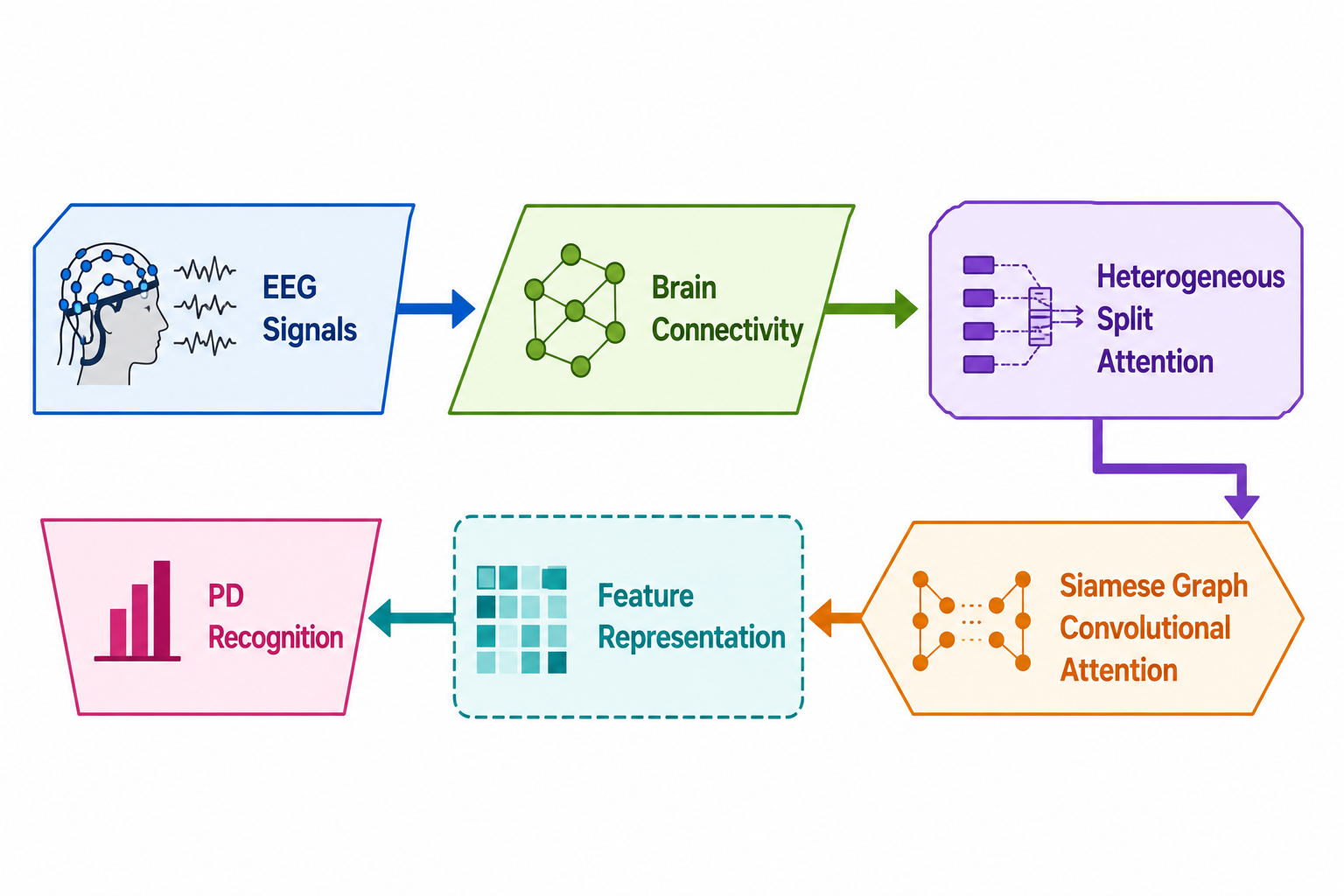
Artificial Intelligence Techniques for Parkinson's Disease Recognition via Heterogeneous Split Attention-Based EEG and Siamese Graph Convolutional Attention Network: Trends and Challenges
Keywords:
Abstract
Parkinson’s disease (PD) is a progressive neurodegenerative disorder characterized by motor and non-motor symptoms, requiring early and accurate diagnosis for effective treatment. Electroencephalography (EEG) has emerged as a promising non-invasive biomarker for PD detection due to its ability to capture neural activity with high temporal resolution. Recent advancements in artificial intelligence (AI), particularly deep learning and graph-based models, have significantly improved EEG-based PD recognition. Deep learning architectures such as convolutional neural networks (CNNs), recurrent neural networks (RNNs), and attention-based models have demonstrated high accuracy in classifying PD from EEG signals. For instance, attention-based graph convolutional neural networks (GCNs) have been proposed to model functional connectivity between EEG channels, achieving improved diagnostic performance. Additionally, hybrid models combining time–frequency analysis with deep learning have achieved classification accuracies exceeding 99% in multi-class EEG tasks. Recent research focuses on integrating heterogeneous split-attention mechanisms and Siamese graph convolutional attention networks to enhance feature extraction and capture inter-channel relationships. These approaches improve classification accuracy by leveraging both spatial and temporal dependencies in EEG data. However, challenges such as data scarcity, noise in EEG signals, and computational complexity remain. This review provides a comprehensive analysis of recent AI techniques, comparing methodologies and highlighting future directions for robust and scalable PD diagnostic systems.