Artificial Intelligence Techniques for Deep ConVGNet: Efficient Framework for Brain Tumour Classification with Masked-Attention Mask Transformer Based Segmentation: Trends and Challenges
Keywords:
Abstract
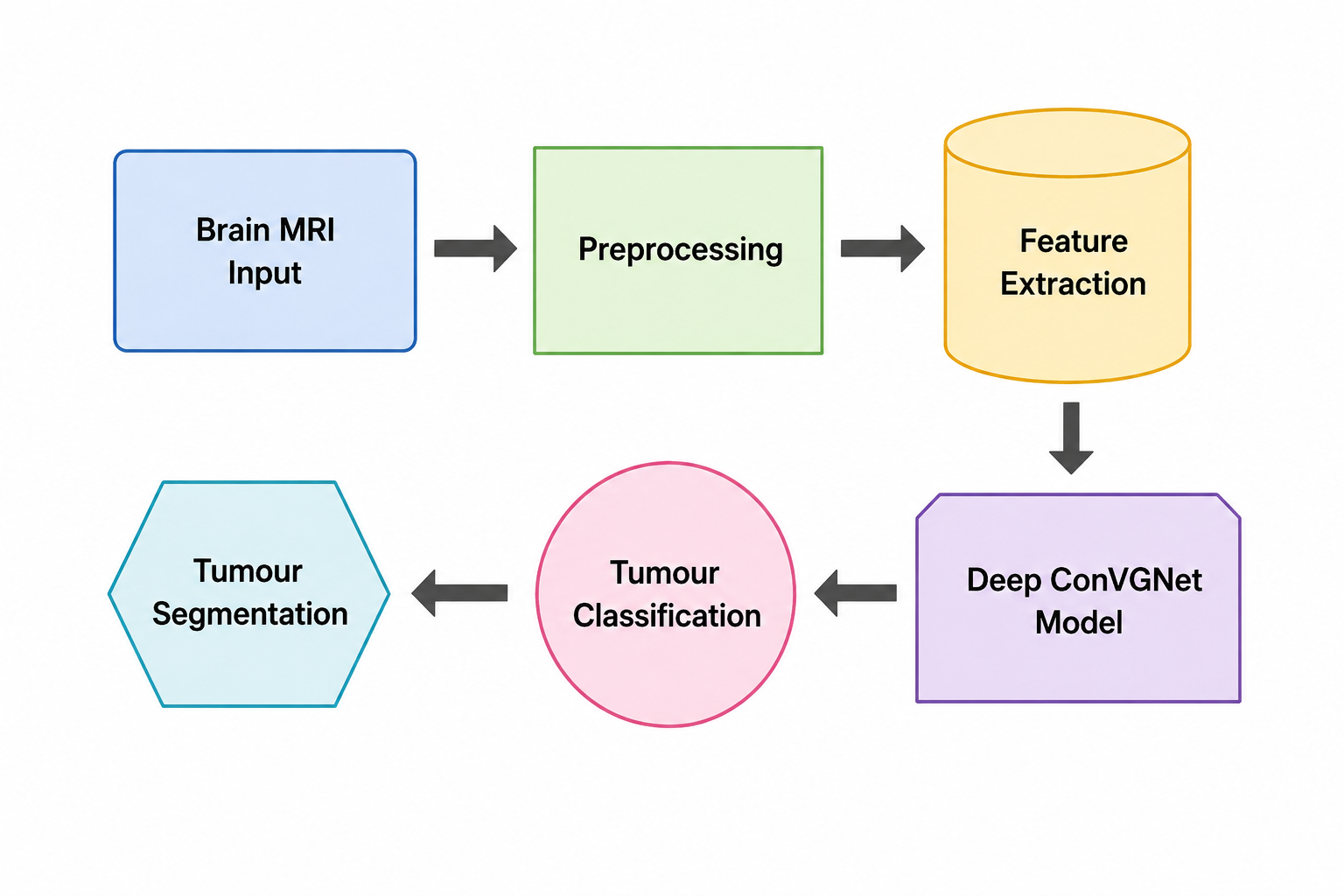
Brain tumour diagnosis is a complex and critical task in medical imaging due to the heterogeneous nature of tumours and the intricate structure of brain tissues. Accurate classification and segmentation from MRI scans are essential for effective treatment planning and prognosis. Traditional methods relying on manual analysis are time-consuming and prone to variability, while recent advancements in deep learning have significantly improved diagnostic capabilities. This paper presents a comprehensive review of artificial intelligence techniques for brain tumour analysis, with a focus on the Deep ConVGNet framework. This hybrid architecture combines convolutional neural networks with transformer-based attention mechanisms, integrating a VGG-inspired backbone with a Masked-Attention Mask Transformer for precise segmentation. The unified framework enables simultaneous tumour classification and pixel-wise delineation, enhancing both efficiency and predictive performance. The masked-attention mechanism improves segmentation accuracy by focusing on relevant regions, particularly beneficial for irregular tumour boundaries. The framework demonstrates strong performance across benchmark datasets such as BraTS, Figshare, and Kaggle Brain MRI, achieving high classification accuracy and Dice Similarity Coefficient scores. Additionally, the review examines optimization strategies, dataset challenges, and deployment considerations, including interpretability and generalization. Overall, this work highlights the potential of hybrid CNN-transformer models in developing accurate, efficient, and clinically applicable brain tumour diagnostic systems.