A Comprehensive Review of Energy Management in Smart Grids Using IoT and Price-Based Demand Response with a Hybrid FHO-RERNN Approach
Keywords:
Abstract
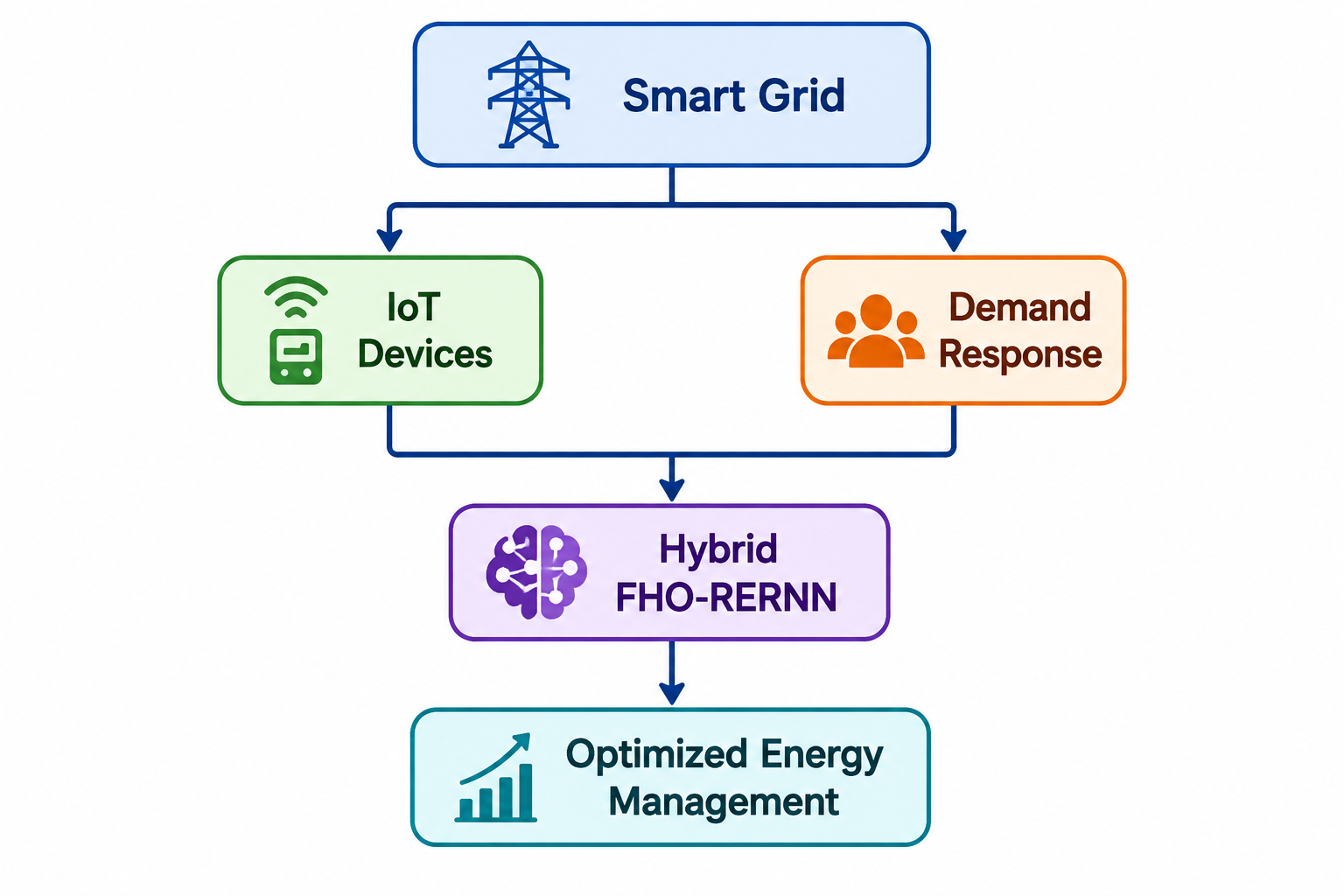
The rapid advancement of smart grid technology has transformed conventional power networks into intelligent, interconnected systems capable of efficiently managing distributed energy resources, renewable generation, and dynamic electricity demand. The integration of the Internet of Things (IoT) has significantly enhanced this transformation by enabling real-time monitoring, automated control, and seamless communication among smart meters, sensors, controllers, and grid operators. Simultaneously, price-based demand response (DR) strategies, including real-time pricing, time-of-use pricing, and critical peak pricing, encourage consumers to shift electricity usage according to pricing signals, thereby reducing peak demand, improving energy efficiency, and enhancing grid reliability. However, the increasing complexity of IoT-enabled smart grids introduces challenges such as communication latency, data heterogeneity, cybersecurity risks, renewable energy uncertainty, and multi-objective optimization. To overcome these issues, hybrid artificial intelligence approaches have emerged as effective solutions. This review focuses on the integration of Flamingo Hunting Optimization (FHO) with Recurrent Elman Neural Networks (RERNN) for intelligent energy management. The RERNN accurately forecasts energy demand, renewable generation, and electricity prices, while FHO optimizes scheduling and demand response decisions under dynamic conditions. The hybrid framework improves prediction accuracy, minimizes operational costs, enhances renewable energy utilization, reduces peak-to-average load ratio, and supports reliable decision-making. Furthermore, this review discusses recent advances, existing challenges, performance evaluation metrics, and future research directions, demonstrating that hybrid FHO-RERNN techniques offer a promising pathway toward sustainable, adaptive, secure, and cost-effective IoT-enabled smart grid energy management systems.