Recent Advances in Enhancing Thermo-Electro-Mechanical Responses of MEMS Resonant Accelerometers with an Attention-Guided Siamese Fusion Neural Network: A Systematic Review
Keywords:
Abstract
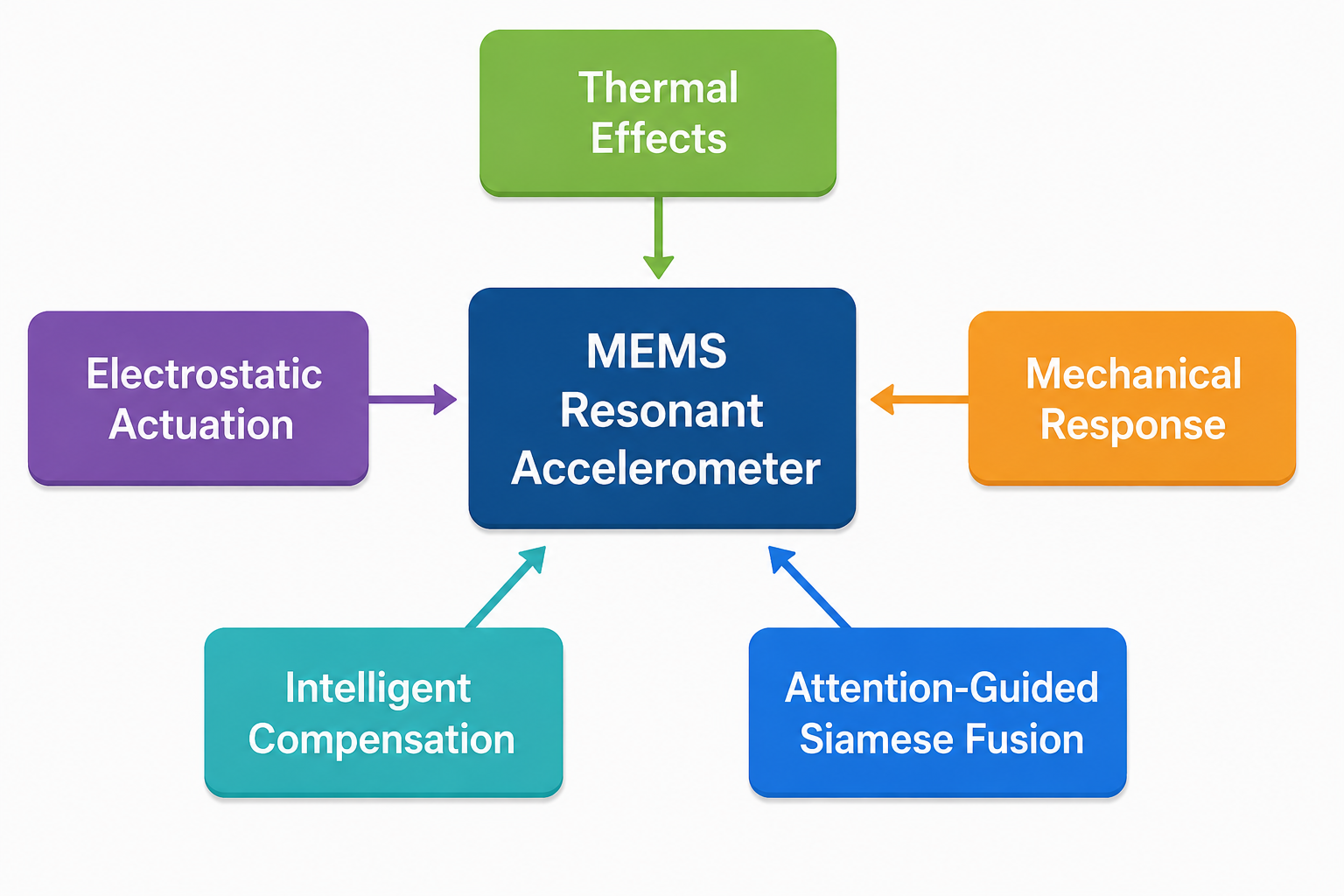
Microelectromechanical systems (MEMS) resonant accelerometers are widely used in aerospace, automotive, industrial automation, and structural health monitoring due to their high sensitivity, compact size, and long-term stability. Their operating principle relies on detecting resonant frequency variations caused by applied acceleration. However, thermo-electro-mechanical interactions, including thermal drift, electrostatic nonlinearities, residual stresses, and structural damping, significantly influence sensing accuracy and reliability. Conventional finite element methods and empirical compensation models often struggle to capture these complex nonlinear effects under varying environmental conditions. This review examines recent advances in enhancing MEMS resonant accelerometer performance through attention-guided Siamese fusion neural networks. By integrating shared-weight Siamese architectures with attention mechanisms, these models effectively learn discriminative representations from multimodal sensing data while emphasizing the most informative thermal, electrical, and mechanical features. The fusion strategy improves frequency shift prediction, thermal compensation, and anomaly detection across diverse operating conditions. Based on recent studies in MEMS physics, intelligent signal processing, and embedded artificial intelligence, the review demonstrates that physics-informed deep learning consistently outperforms conventional modeling techniques. Attention-guided Siamese fusion networks achieve superior prediction accuracy, robust generalization, and improved resilience against environmental variations. These findings highlight the potential of intelligent multiphysics modeling for next-generation MEMS resonant accelerometers, supporting high-precision inertial sensing in autonomous navigation, structural health monitoring, precision instrumentation, and advanced embedded sensing applications.