Artificial Intelligence Techniques for EEG-based Classification of Neuropsychiatric Disorders Using Deep Sparse Neural Networks with Gooseneck Barnacle Optimization Algorithm: Trends and Challenges
Keywords:
Abstract
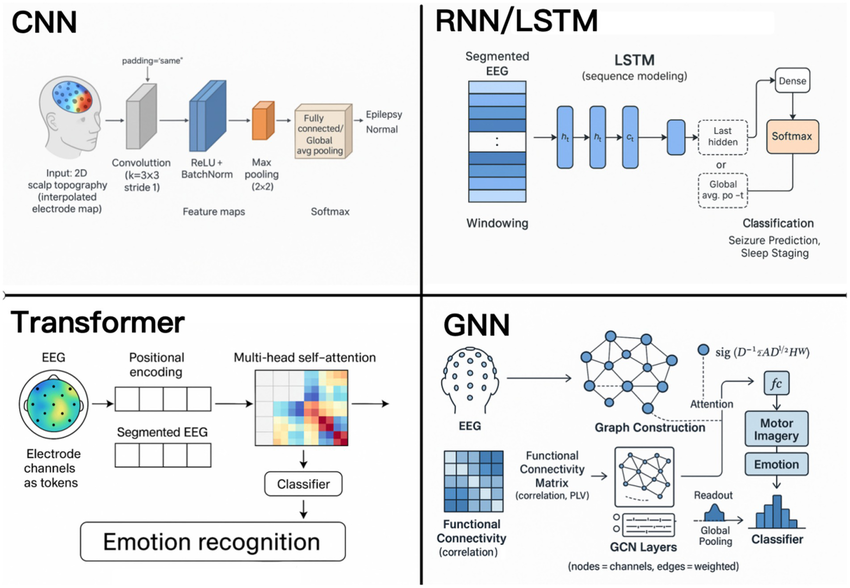
Electroencephalography (EEG)-based diagnosis of neuropsychiatric disorders has gained significant attention due to its non-invasive nature and ability to capture real-time brain activity. Recent advancements in artificial intelligence, particularly deep learning, have enabled automated classification of disorders such as depression, schizophrenia, and epilepsy with improved accuracy. However, challenges such as high dimensionality, noise, and inter-subject variability limit traditional machine learning approaches. This study presents a comprehensive review of artificial intelligence techniques for EEG-based classification, focusing on deep sparse neural networks optimized using bio-inspired algorithms such as the Gooseneck Barnacle Optimization Algorithm (GBOA). Sparse neural architectures reduce computational complexity while preserving discriminative features, making them suitable for real-time healthcare applications. Optimization algorithms enhance feature selection, parameter tuning, and convergence performance. The paper analyzes recent literature, comparing deep learning architectures, optimization strategies, and performance metrics. A comparative evaluation highlights the effectiveness of hybrid AI models combining convolutional neural networks, graph neural networks, and evolutionary optimization techniques. Furthermore, the study identifies key challenges such as data scarcity, model interpretability, and generalization. The findings demonstrate that integrating deep sparse learning with advanced optimization significantly improves classification accuracy and efficiency, paving the way for next-generation intelligent diagnostic systems in neuropsychiatric healthcare.