Neurosense: A Machine Learning Framework for EEG Motor Imagery Classification and Visualization
Keywords:
Abstract
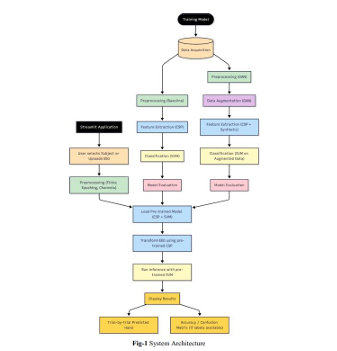
Electroencephalography (EEG)- grounded Brain- Computer Interfaces (BCIs) grease anon-invasive communication link between the mortal nervous sys- tem and external bias, presenting considerable pledge in neurorehabilitation and assistive technologies. nonethe- less, precise bracket of motor imagery( MI) signals con- tinues to be a redoubtable challenge owing to natural signalnon-stationarity, lowered signal- to- noise rates, and considerableinter-subject variability. This paper describes the design and full testing of NeuroSense, a platform for classifying EEG motor imagery from launch to finish. The system uses a structured signal processing channel that includes bandpass filtering, time- grounded segmentation, Common Spatial Pattern (CSP) point birth, and a cali- brated Radial Base Function (RBF) Support Vector Ma- chine (SVM) classifier. During the development phase, sev- eral modeling strategies were delved, including a Genera- tive Adversarial Network (GAN)- grounded system for data addition and point improvement. This approach gave us useful experimental information, but the final system de- sign puts a streamlined CSP- SVM channel at the top of the list because it’s harmonious, easy to understand, and has strong empirical performance. The performing frame shows strong and harmonious bracket performance across subjects on standard EEG motor imagery datasets. Also, a web- grounded interactive interface makes it possible to see EEG data in real time, dissect Power Spectral viscosity (PSD), interpret CSP patterns, and make prognostications for each trial with an estimation of confidence. This makes it easier for both clinical interpreters and experimenters to use. The suggested system has a mean bracket delicacy of 84.4 and a Cohen’s kappa of 0.688, which shows that it works well and constantly across subjects.