Impact of Traffic Congestion on Emergency Vehicles
Keywords:
Abstract
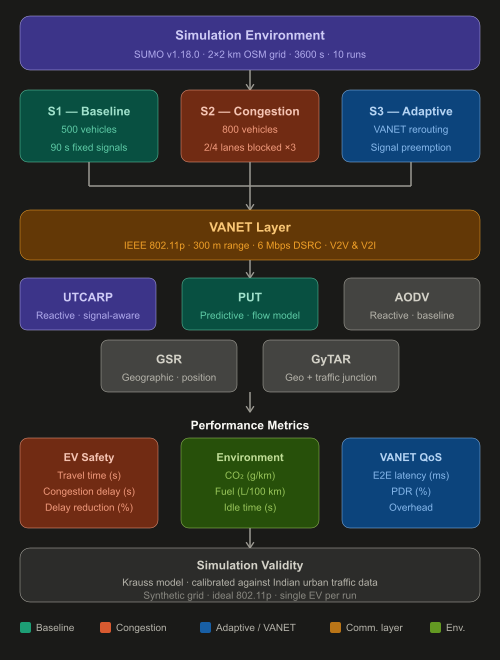
Traffic congestion appreciably degrades emergency car (EV) response effectiveness, with direct consequences for public protection and urban sustainability. This paper investigates the effect of city traffic congestion on EV travel time, CO₂ emissions, and gas consumption the usage of an incorporated SUMO (v1.18.0) and VANET simulation framework. Three experimental situations — baseline loose-waft (S1), congested (S2), and adaptive ITMS (S3) — have been evaluated across ten repeated simulation runs on a 2 km × 2 km urban grid. Congestion increases EV travel time by way of 232.54 ± 15.3 seconds (3.33×), increases CO₂ emissions by 30%, and increases idle time by using 623%. VANET-based totally rerouting and adaptive signal preemption in S3 recovers 70.1% of congestion-induced postpone and reduces CO₂ by using 50%. UTCARP and PUT outperform benchmarks by 35% and 25% in end-to-give up latency respectively, maintaining the viability of ITMS as a clever metropolis infrastructure investment [1]-[18].