Bridging the Gap: A Data-Driven Approach Data-Driven Solutions for Public Transportation Challenges in India
Keywords:
Abstract
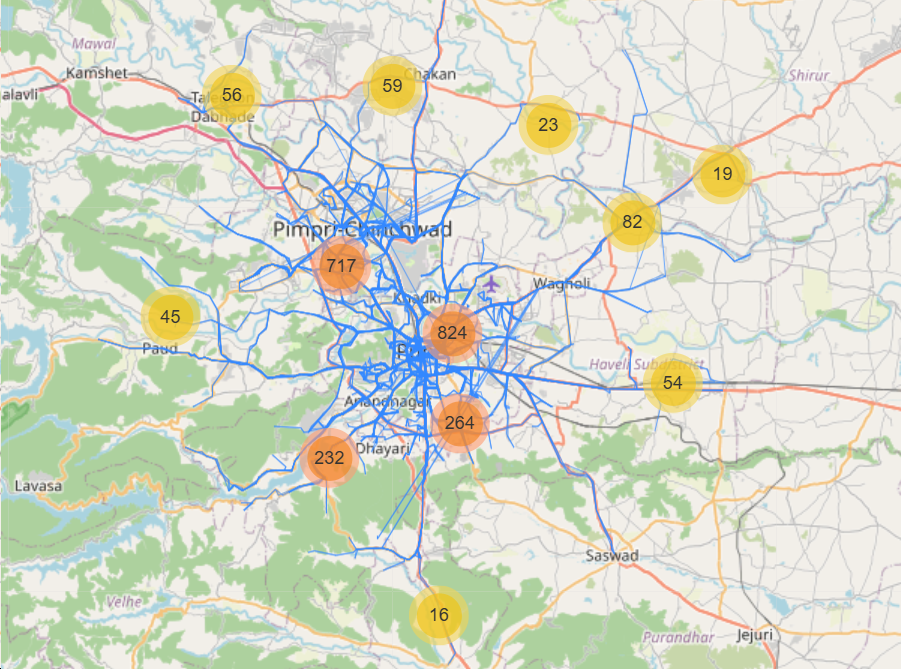
This research investigates the operational inefficiencies in India’s public transportation system through a case study of Pune Mahanagar Parivahan Mahamandal Limited (PMPML). Rapid urbanization has placed significant pressure on existing transport infrastructure, leading to issues such as overcrowding, unreliable services, and declining operational efficiency. This study utilizes data from PMPML’s annual reports along with geospatial analysis of bus stop distributions to evaluate key performance indicators, including fleet utilization, service reliability, passenger demand, and complaint trends. The analysis reveals a critical operational paradox where mechanical reliability has improved, yet service performance has deteriorated, as evidenced by increasing service cancellations and passenger complaints. By integrating statistical and geospatial techniques, the study identifies inefficiencies in fleet deployment, demand–supply mismatches, and uneven spatial distribution of services. To address these challenges, the paper proposes a data-driven framework leveraging data science, artificial intelligence, and machine learning techniques, including demand forecasting models, route optimization algorithms, and real-time scheduling systems. These approaches enable dynamic decision-making, improved resource allocation, and enhanced service reliability. The findings demonstrate that the observed inefficiencies are not primarily due to infrastructure limitations but rather the absence of intelligent, data-driven management systems. The study emphasizes the need for a paradigm shift toward predictive and adaptive transport systems to improve efficiency, passenger satisfaction, and sustainability in urban public transportation.