Energy-Efficient Routing Algorithms for AI-Enabled Internet of Things Networks
Keywords:
Abstract
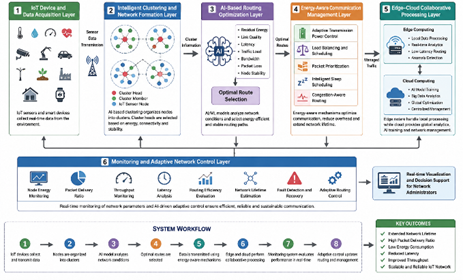
The rapid growth of Artificial Intelligence (AI) and Internet of Things (IoT) technologies has significantly transformed modern communication infrastructures by enabling intelligent sensing, real-time analytics, autonomous decision-making, and large-scale smart device connectivity. AI-enabled IoT networks are increasingly deployed in smart cities, healthcare systems, industrial automation, transportation systems, agriculture, environmental monitoring, and intelligent surveillance applications. However, the continuous expansion of IoT ecosystems introduces major challenges related to energy consumption, routing efficiency, network scalability, communication latency, bandwidth utilization, and resource-constrained sensor operations. Traditional routing protocols often experience limitations in dynamic IoT environments due to inefficient energy management, unbalanced network traffic, excessive communication overhead, and reduced adaptability to changing network conditions. These limitations significantly affect network lifetime, operational reliability, and intelligent communication performance in AI-assisted IoT systems. To address these challenges, this research proposes Energy-Efficient Routing Algorithms for AI-Enabled Internet of Things Networks that integrate Artificial Intelligence, adaptive routing optimization, machine learning-assisted traffic management, intelligent clustering, and energy-aware communication mechanisms into a unified IoT networking framework. The proposed architecture utilizes AI-driven routing intelligence to dynamically optimize data transmission paths, minimize communication energy consumption, balance network workloads, and improve packet delivery efficiency across distributed IoT environments. The framework incorporates deep learning-based traffic prediction, intelligent node selection, adaptive route discovery, and energy-aware cluster management to enhance network sustainability and operational scalability. Furthermore, the proposed system integrates real-time network monitoring, intelligent fault tolerance, and adaptive communication orchestration for supporting large-scale next-generation IoT infrastructures.