Hybrid Metaheuristic Optimization Techniques for Cloud Task Scheduling and Resource Management
Keywords:
Abstract
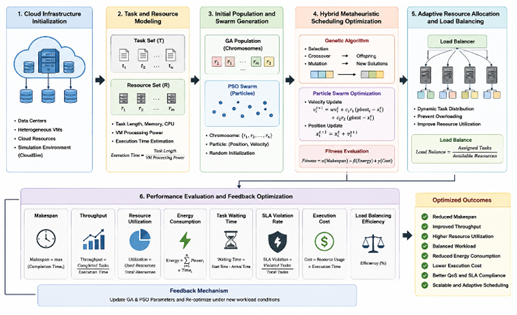
The rapid growth of cloud computing, distributed systems, Internet of Things (IoT), big data analytics, and Artificial Intelligence (AI) applications has significantly increased the demand for efficient cloud task scheduling and intelligent resource management mechanisms. Cloud computing environments provide scalable, on-demand, and virtualized computing resources capable of supporting heterogeneous workloads, large-scale data processing, and dynamic service delivery across geographically distributed infrastructures. However, increasing workload diversity, resource heterogeneity, dynamic task arrival, service-level agreement (SLA) requirements, energy consumption, and Quality of Service (QoS) optimization introduce major challenges for efficient task scheduling and resource allocation within cloud computing environments. Traditional scheduling algorithms such as First-Come-First-Serve (FCFS), Round Robin, and heuristic-based resource allocation strategies frequently suffer from poor scalability, inefficient load balancing, increased execution delay, high energy consumption, and suboptimal resource utilization under dynamic cloud workloads. Metaheuristic optimization algorithms have emerged as highly effective solutions for addressing complex cloud scheduling and resource management problems due to their strong global search capability, adaptive optimization behavior, and ability to efficiently solve NP-hard optimization problems. Algorithms such as Genetic Algorithms (GA), Particle Swarm Optimization (PSO), Ant Colony Optimization (ACO), Whale Optimization Algorithm (WOA), and Differential Evolution (DE) have demonstrated significant potential for improving cloud resource allocation, minimizing task execution time, reducing makespan, and enhancing load balancing within cloud infrastructures. However, standalone metaheuristic algorithms frequently suffer from premature convergence, local optima stagnation, insufficient exploration–exploitation balance, and reduced optimization stability under large-scale heterogeneous cloud environments.