AI-Driven Cyber Threat Intelligence Frameworks for Next-Generation Network Security
Keywords:
Abstract
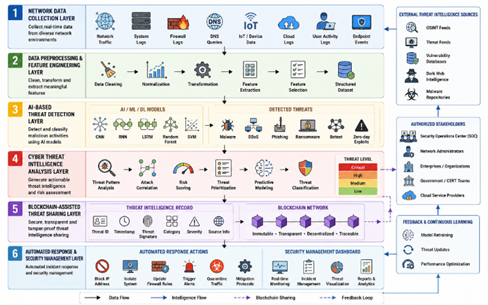
The rapid growth of digital communication infrastructures, cloud computing, Internet of Things (IoT) devices, and intelligent networked systems has significantly increased the complexity and frequency of cyberattacks in modern network environments. Traditional cybersecurity mechanisms are often unable to detect advanced persistent threats, zero-day attacks, ransomware, distributed denial-of-service (DDoS) attacks, and sophisticated malware due to the dynamic and evolving nature of cyber threats. Consequently, Artificial Intelligence (AI)-driven Cyber Threat Intelligence (CTI) frameworks have emerged as a promising solution for enhancing next-generation network security through intelligent threat detection, predictive analytics, automated response mechanisms, and adaptive security management. This research proposes an AI-Driven Cyber Threat Intelligence Framework for Next-Generation Network Security that integrates machine learning, deep learning, threat intelligence analytics, behavioral monitoring, and real-time network traffic analysis into a unified cybersecurity architecture. The proposed framework utilizes intelligent data collection mechanisms, anomaly detection models, threat classification algorithms, and automated response engines to identify and mitigate cyber threats efficiently. The architecture combines deep neural networks, natural language processing (NLP), and blockchain-assisted threat intelligence sharing to improve security transparency, collaborative defense, and attack traceability across distributed network infrastructures. Furthermore, the framework incorporates adaptive learning models that continuously update threat patterns and optimize intrusion detection accuracy in dynamic network environments. Experimental evaluation demonstrates that the proposed framework significantly improves threat detection accuracy, attack prediction capability, response efficiency, and false-positive reduction compared with traditional security systems. The proposed model also enhances network resilience, scalability, and real-time cybersecurity intelligence in cloud, IoT, and enterprise network environments. The study establishes a robust AI-driven cybersecurity foundation for securing future intelligent communication networks against emerging cyber threats.