Deep Reinforcement Learning for Adaptive Resource Allocation in 6G Wireless Networks
Keywords:
Abstract
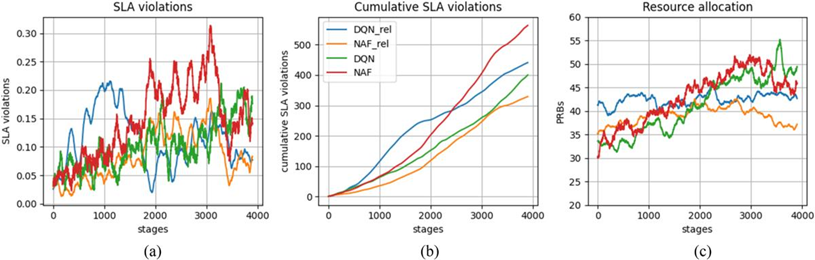
The emergence of 6G wireless networks introduces unprecedented challenges in dynamic resource allocation due to extreme requirements for ultra-low latency, massive connectivity, high energy efficiency, and intelligent spectrum utilization. Traditional optimization and heuristic-based resource allocation techniques struggle to adapt to the highly dynamic, heterogeneous, and large-scale nature of 6G environments. To address these limitations, Deep Reinforcement Learning (DRL) has emerged as a promising paradigm for adaptive and intelligent resource management in next-generation wireless systems. This research proposes a Deep Reinforcement Learning Framework for Adaptive Resource Allocation in 6G Wireless Networks, designed to optimize spectrum allocation, power control, user scheduling, and network slicing in real-time dynamic environments. The framework leverages advanced DRL architectures such as Deep Q-Networks (DQN), Proximal Policy Optimization (PPO), and Actor-Critic methods to learn optimal policies from continuous network interactions. The proposed system integrates network state representation, reward-driven optimization, and environment-aware learning to dynamically allocate resources while maximizing throughput, minimizing latency, and improving energy efficiency. Simulation results demonstrate that the DRL-based framework significantly outperforms traditional optimization methods in terms of spectral efficiency, convergence speed, and adaptive decision-making capability under varying network loads. The study contributes a scalable and intelligent resource allocation framework suitable for complex 6G scenarios such as ultra-dense networks, IoT-driven communication systems, and intelligent edge computing environments. The results confirm that DRL-based adaptive control is a viable solution for next-generation wireless network optimization problems.