Federated Deep Learning Frameworks for Privacy-Preserving Intelligent Healthcare Systems
Keywords:
Abstract
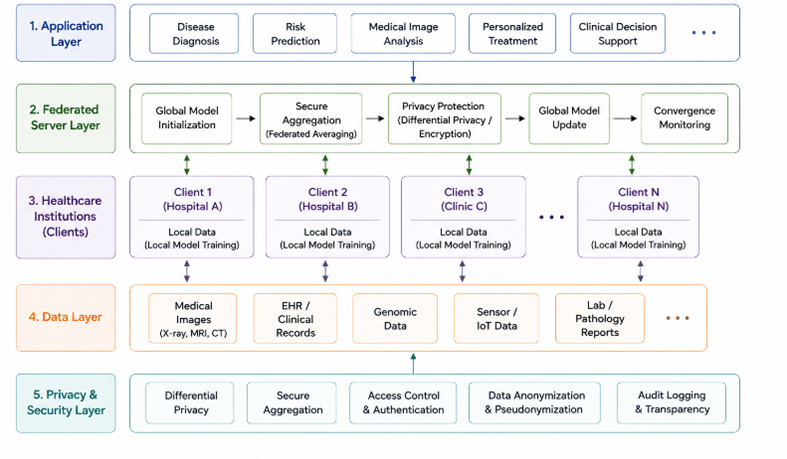
The rapid growth of intelligent healthcare systems, Internet of Medical Things (IoMT), wearable biosensors, cloud-based medical analytics, and artificial intelligence (AI)-driven clinical decision support has significantly transformed modern healthcare infrastructures. Contemporary healthcare ecosystems continuously generate massive volumes of sensitive patient information, including electronic health records (EHRs), medical imaging data, physiological sensor streams, genomic analytics, and real-time diagnostic observations. Deep learning architectures have demonstrated remarkable effectiveness in disease diagnosis, medical image analysis, patient risk prediction, clinical decision support, and personalized healthcare analytics. However, traditional centralized deep learning frameworks require aggregating sensitive patient data into centralized cloud servers, thereby introducing substantial concerns related to patient privacy, data confidentiality, cybersecurity risks, regulatory compliance, and unauthorized information exposure. Federated Deep Learning (FDL) has emerged as a promising decentralized AI paradigm capable of enabling collaborative model training across distributed healthcare institutions without directly sharing raw patient data. Federated learning allows hospitals, clinics, IoMT infrastructures, and edge-enabled healthcare devices to locally train intelligent models while only exchanging encrypted model parameters and learned representations with centralized or distributed aggregation servers. This decentralized intelligent coordination significantly improves privacy preservation, communication efficiency, distributed scalability, and trustworthy healthcare analytics across heterogeneous healthcare ecosystems. This research proposes a Federated Deep Learning Framework for Privacy-Preserving Intelligent Healthcare Systems designed to optimize distributed medical intelligence, secure collaborative analytics, adaptive healthcare coordination, privacy-preserving deep learning inference, and low-latency intelligent healthcare decision support across large-scale distributed medical infrastructures.