Deep Learning and Optimization Approaches in an Efficient Cascaded Deep Capsule Cell Attention Network Model for Breast Cancer Molecular Subtypes Prediction Using Mammogram Images: A Review
DOI:
https://doi.org/10.65521/mjret.v12i2.2795Keywords:
Abstract
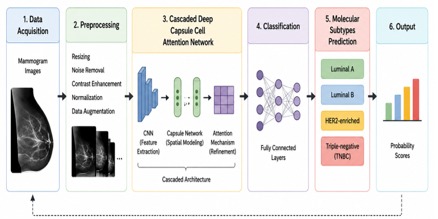
Breast cancer remains one of the leading causes of mortality among women worldwide, necessitating accurate and early diagnosis for effective treatment. Molecular subtype prediction, including Luminal A, Luminal B, HER2-enriched, and triple-negative breast cancer, plays a critical role in personalized therapy planning. Traditionally, subtype identification relies on invasive biopsy procedures, which are time-consuming and costly. Recent advancements in deep learning have enabled non-invasive prediction using mammogram images, significantly improving diagnostic efficiency. This review focuses on deep learning and optimization approaches for breast cancer molecular subtype prediction, emphasizing cascaded deep capsule cell attention network architectures. Convolutional Neural Networks (CNNs) provide strong feature extraction capabilities, while Capsule Networks (CapsNets) preserve spatial relationships and hierarchical structures. Attention mechanisms enhance model performance by focusing on relevant regions, improving both segmentation and classification accuracy. Optimization techniques such as transfer learning, feature fusion, hyperparameter tuning, and metaheuristic algorithms further enhance model efficiency and generalization. The review analyzes recent studies, compares various architectures, and identifies key challenges, including data scarcity, computational complexity, and lack of interpretability. The findings indicate that hybrid and cascaded models integrating CNNs, CapsNets, and attention mechanisms outperform traditional approaches. Future research directions include explainable AI, multimodal learning, and lightweight models for real-time clinical deployment.
Breast Cancer, Molecular Subtypes, Deep Learning, Capsule Networks, Attention Mechanism, Cascaded Architecture, Mammogram Images, Optimization Techniques, CNN, Medical Image Analysis