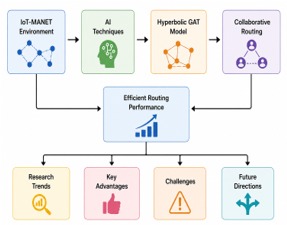
Artificial Intelligence Techniques for Deep Hyperbolic Graph Attention Network-Based Collaborative Routing Algorithm for Clustered IoT-Manets: Trends and Challenges
DOI:
https://doi.org/10.65521/mjret.v12i2.2792Keywords:
Abstract
The increasing adoption of Internet of Things (iot) technologies and mobile wireless communication has created a growing need for intelligent and efficient routing mechanisms in Mobile Ad Hoc Networks (manets). Iot-MANET systems operate in dynamic and infrastructure-less environments where nodes frequently change positions, causing topology variations and communication challenges. Traditional routing protocols often struggle to maintain network efficiency under such conditions due to limited adaptability and high routing overhead. Artificial intelligence (AI) techniques have recently emerged as promising solutions for addressing these challenges by enabling adaptive and intelligent routing decisions. This paper reviews recent advances in artificial intelligence techniques applied to Deep Hyperbolic Graph Attention Network-based collaborative routing algorithms for clustered iot-MANET systems. AI-driven approaches such as Graph Neural Networks, Graph Attention Networks, reinforcement learning, and optimization algorithms have demonstrated the ability to model complex network structures and improve routing performance. Hyperbolic graph embeddings further enhance these models by effectively representing hierarchical network relationships in clustered communication environments. The study discusses current research trends, evaluates the advantages of AI-based routing approaches, and highlights major challenges including computational complexity, scalability, and limited training data. Finally, the review identifies future research directions for developing efficient, scalable, and energy-aware intelligent routing frameworks for next-generation iot-MANET networks.