A Comprehensive Review of Joint Power and Delay Optimization Based Resource Allocation in MIMO-OFDM System Using Deep Convolutional Red Piranha Pyramid-Dilated Neural Network
DOI:
https://doi.org/10.65521/mjret.v12i2.2787Keywords:
Abstract
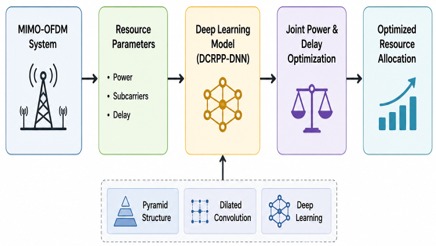
The rapid evolution of next-generation wireless communication systems, particularly 5G and emerging 6G networks, has intensified the demand for efficient resource allocation strategies in MIMO-OFDM systems. Joint optimization of power and delay plays a crucial role in improving system throughput, minimizing latency, and ensuring energy efficiency. Traditional optimization approaches often struggle with high computational complexity and dynamic network conditions. To address these challenges, deep learning-based techniques have emerged as powerful alternatives. This paper presents a comprehensive review of joint power and delay optimization techniques, focusing on advanced neural network architectures such as Deep Convolutional Red Piranha Pyramid-Dilated Neural Networks (DCRPP-DNN). These models leverage hierarchical feature extraction, multi-scale learning, and dilated convolutions to effectively capture channel dynamics and optimize resource allocation. The review analyses recent advancements in deep learning-driven resource allocation, including reinforcement learning, hybrid optimization, and CNN-based models. Furthermore, the study highlights key challenges such as scalability, real-time adaptability, and model complexity. Comparative insights reveal that deep learning-based approaches significantly outperform conventional methods in terms of spectral efficiency, latency reduction, and robustness under dynamic channel conditions. This work provides a foundation for future research in intelligent resource management for next-generation wireless networks.