Recent Advances in Power Electronics Converters for Renewable Energy Applications
DOI:
https://doi.org/10.65521/itsi-teee.v4i1.4263Keywords:
Abstract
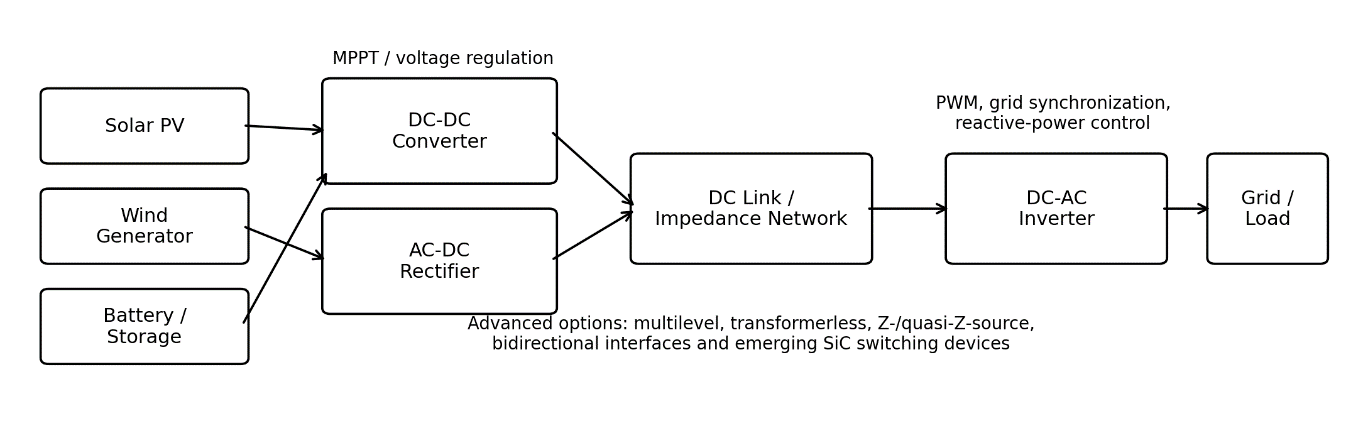
This paper reviews and methodologically compares the principal advances in power-electronic converters used for renewable-energy conversion up to 2015. The study focuses on photovoltaic (PV), wind and storage-coupled interfaces and evaluates the progression from conventional two-stage conversion toward transformerless, multilevel, impedance-source, module-integrated and full-scale converter structures. A structured literature-selection procedure was applied to peer-reviewed studies with traceable DOI records. Converter families were classified by conversion stage, voltage-gain capability, isolation, switch stress, harmonic performance, component count, control complexity, scalability and suitability for maximum-power-point tracking (MPPT) and grid support. The synthesis shows that no single topology dominates all renewable applications. Transformerless PV inverters improve efficiency and power density but demand careful leakage-current control; multilevel converters reduce device stress and output harmonics at medium-to-high power; Z-source concepts combine buck-boost conversion and inversion; full-scale back-to-back converters increase controllability in modern wind turbines; and silicon-carbide devices offer a route to higher switching frequency and reduced losses. The paper concludes that converter selection should be application-specific and jointly optimized for efficiency, reliability, power quality, cost and grid-code compliance.