Speed Control of DC Motors Using PID and Fuzzy Logic Controllers: A Comparative Study
DOI:
https://doi.org/10.65521/itsi-teee.v4i1.4260Keywords:
Abstract
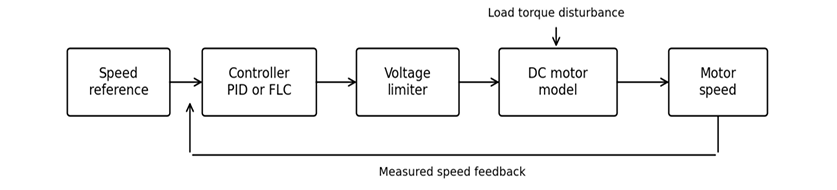
This methodology paper presents a reproducible comparative framework for evaluating proportional-integral-derivative (PID) and fuzzy logic controllers (FLCs) for the speed regulation of a separately excited direct-current (DC) motor. A common electromechanical motor model, identical voltage saturation, the same reference speed, and the same external load disturbance are used so that differences in response arise from the control strategy rather than from unequal test conditions. The PID controller is tuned for a stable compromise between rise time, overshoot, settling time, and steady-state error. The fuzzy controller uses speed error and error derivative as inputs, five linguistic terms per input, a 25-rule Mamdani-type rule base, and centroid-style weighted defuzzification. MATLAB/Simulink is the intended implementation environment; the numerical results reported here were reproduced from the stated differential equations using an equivalent time-domain simulation. For a 150 rad/s command, the PID response reaches the target faster initially, but exhibits about 6.20% overshoot and settles in approximately 0.596 s. The fuzzy controller reduces overshoot to about 0.64% and settles in about 0.300 s, although its non-integrating rule structure leaves a small post-disturbance speed offset of about 0.93%. The comparison therefore indicates that fuzzy logic provides superior transient damping and smoothness, while PID retains an advantage in eliminating constant steady-state error when integral action is properly tuned. The methodology can be used as a baseline for later hardware-in-the-loop or laboratory validation.