FPGA-Based Digital Signal Processing for Real-Time Communication Applications
DOI:
https://doi.org/10.65521/itsi-teee.v5i1.4248Keywords:
Abstract
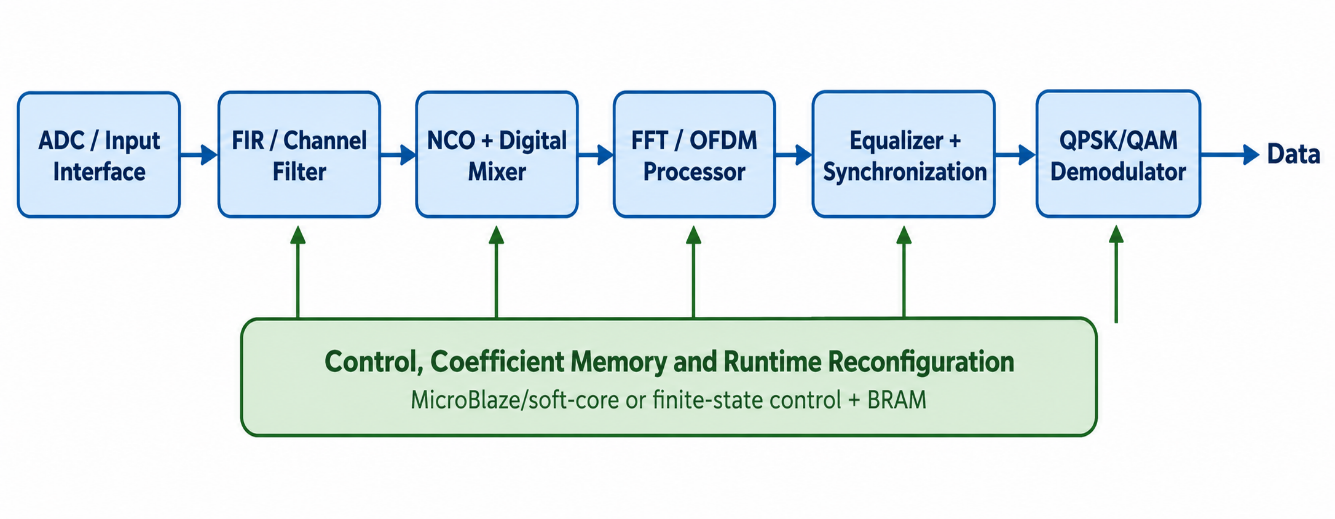
Field-programmable gate arrays (FPGAs) provide a practical hardware platform for real-time digital signal processing (DSP) because they combine deterministic timing, fine-grained parallelism, reconfigurability, embedded multiplier-accumulator resources, and direct interfaces to high-speed data converters. This paper presents a methodology for designing an FPGA-based DSP chain intended for real-time communication applications such as software-defined radio (SDR), orthogonal frequency-division multiplexing (OFDM), and broadband digital receivers. The proposed method decomposes the communication receiver into streaming hardware stages comprising input buffering, finite-impulse-response (FIR) filtering, numerically controlled mixing, fast Fourier transform (FFT) processing, synchronization/equalization, and QPSK/QAM demodulation. Fixed-point arithmetic, pipelining, parallel multiply-accumulate operations, and block-RAM buffering are used to meet deterministic throughput and latency objectives while controlling resource utilization and power. A verification workflow combining floating-point reference models, fixed-point bit-accurate simulation, HDL co-simulation, synthesis, timing analysis, and hardware-in-the-loop validation is defined. Methodology-level calculations show that a one-sample-per-clock streaming chain at 100 MHz can sustain 100 MS/s, while pipelined DSP blocks keep stage latency in the sub-microsecond to few-microsecond range depending on transform size. The study concludes that FPGA-based DSP is particularly suitable when communication systems require high sample rates, repeatable latency, and run-time reconfiguration without the non-recurring engineering cost of an ASIC.