Design of an Embedded System for Industrial Temperature Monitoring
DOI:
https://doi.org/10.65521/itsi-teee.v7i1.4236Keywords:
Abstract
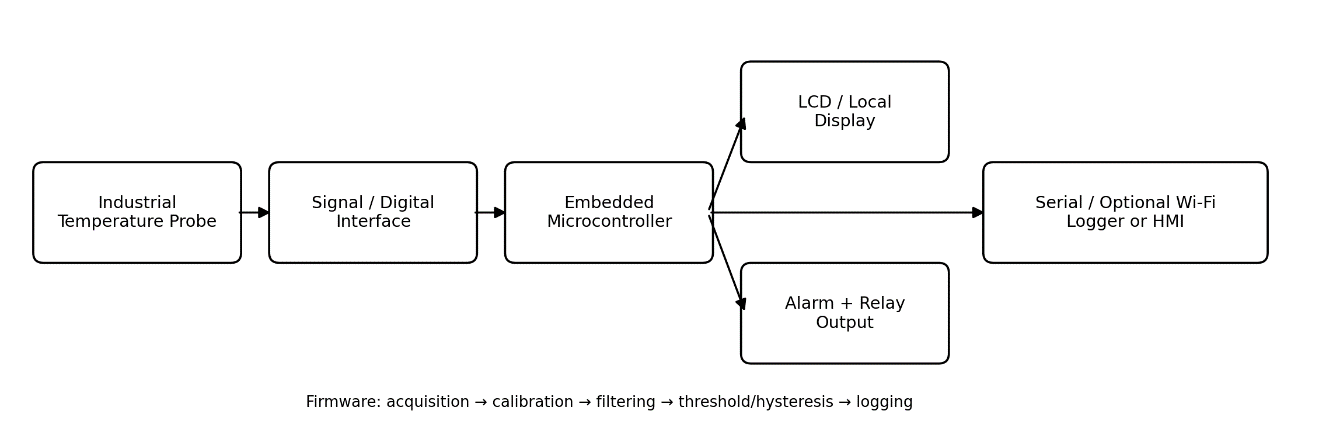
Industrial equipment frequently operates under thermal conditions in which sustained overheating can accelerate insulation ageing, alter material properties, reduce process quality, and precede mechanical or electrical failure. This methodology paper presents the design of a compact embedded system for continuous industrial temperature monitoring. The proposed architecture integrates an industrial temperature probe, a signal-conditioning or digital interface, a microcontroller, local display, threshold-based alarm and relay outputs, and an optional serial or wireless link for supervisory logging. The firmware follows a deterministic acquisition cycle consisting of sensor reading, two-point calibration, moving-average filtering, limit comparison with hysteresis, alarm generation, data display, and communication. The design emphasizes local decision making so that critical alarms remain available even when a network connection is unavailable. A structured validation procedure is defined using reference temperature points, absolute error, mean absolute error, root-mean-square error, alarm response time, and data continuity. For methodological demonstration, an illustrative calibration dataset gives a mean absolute error of approximately 0.32 °C and a maximum absolute error of 0.50 °Cover 25-150 °C. These values are not presented as certified field measurements; they demonstrate how the proposed prototype should be evaluated and reported. The resulting framework provides a low-cost and reproducible basis for equipment-temperature surveillance, preventive maintenance, and future integration with industrial supervisory systems.