Power Quality Improvement in Distribution Networks Using Unified Power Quality Conditioner
DOI:
https://doi.org/10.65521/itsi-teee.v10i1.4226Keywords:
Abstract
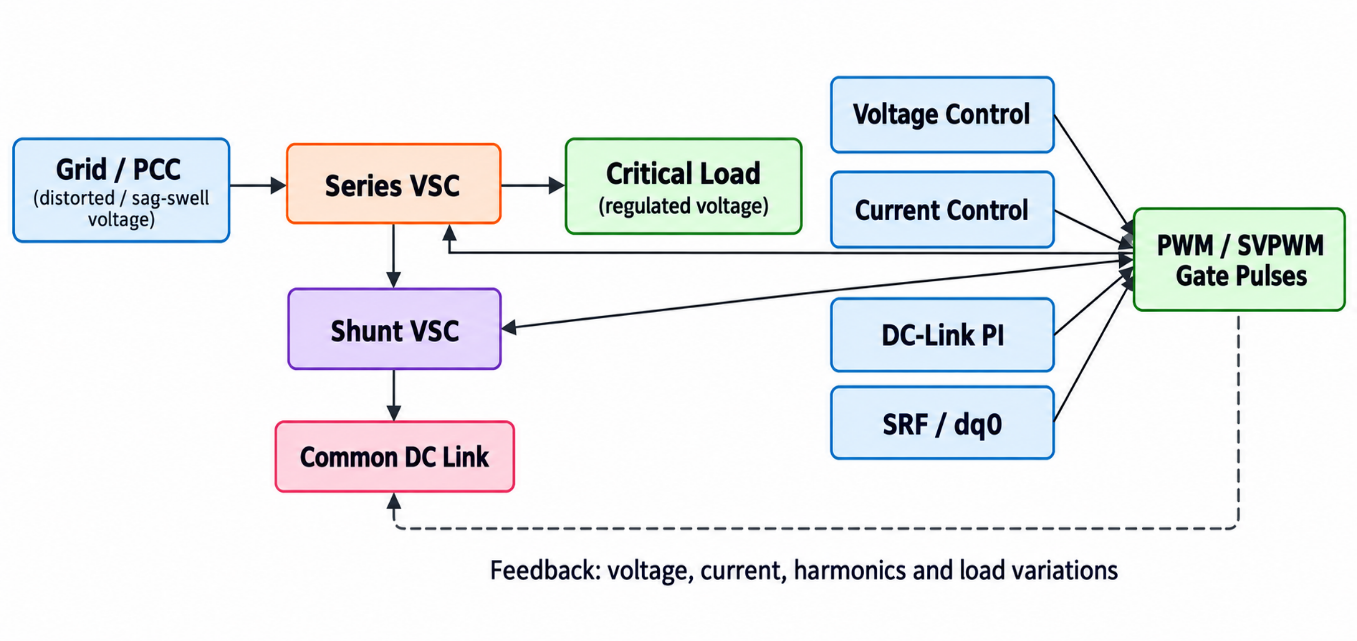
Power-quality disturbances in modern distribution networks are intensified by nonlinear electronic loads, converter-interfaced renewable generation, unbalanced loading, and sensitive industrial processes. This methodology paper develops a simulation-oriented framework for improving distribution-level power quality using a Unified Power Quality Conditioner (UPQC). The proposed UPQC combines a series voltage-source converter and a shunt voltage-source converter coupled through a common DC link. The series converter is designed to compensate voltage sag, swell, unbalance, and voltage harmonics, while the shunt converter mitigates load-current harmonics, supplies reactive current, improves source power factor, and regulates the DC-link voltage. A synchronous-reference-frame (dq) method is adopted for reference extraction, with proportional-integral regulation of the DC bus and carrier-based PWM/SVPWM switching. Performance is assessed under nonlinear loading, a 30% voltage sag, a 20% swell, and distorted supply conditions. The evaluation indicators are load-voltage regulation, current and voltage total harmonic distortion (THD), source power factor, and DC-link recovery. Representative simulation outcomes show that the proposed framework can restore the load voltage close to 1.0 p.u., reduce source-current THD below 5%, and raise the source power factor toward unity. The methodology is suitable for reproducible MATLAB/Simulink implementation and comparative UPQC control studies.