Fault Detection and Protection Coordination in Modern Electrical Distribution Networks
DOI:
https://doi.org/10.65521/itsi-teee.v8i1.4222Keywords:
Abstract
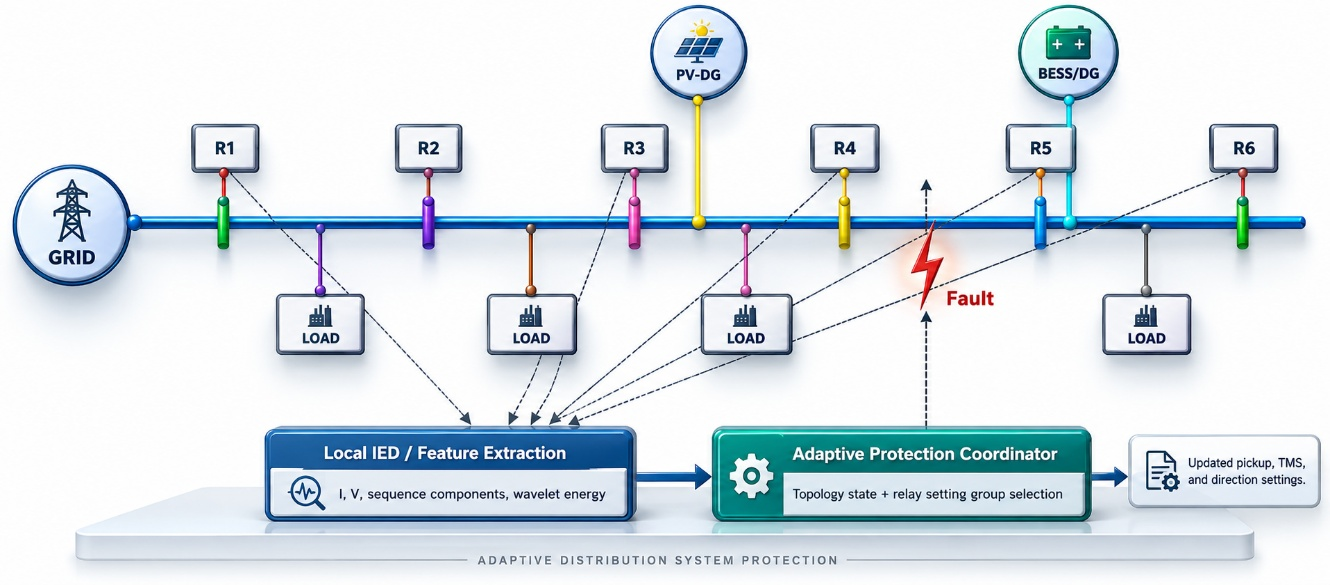
Modern electrical distribution networks are increasingly characterized by bidirectional power flow, inverter-interfaced distributed generation (DG), changing network topology, and a mixture of conventional and intelligent protective devices. These conditions can alter short-circuit levels and cause protection blinding, sympathetic tripping, loss of relay selectivity, and inadequate coordination margins. This paper presents a structured methodology for real-time fault detection and adaptive protection coordination in radial and weakly meshed distribution networks. The framework combines local current-voltage measurements, sequence-component and transient-energy features, directional fault discrimination, topology-aware fault section identification, and adaptive selection of relay pickup and time-multiplier settings. A representative medium-voltage feeder with renewable DG is used to define fault scenarios covering single-line-to-ground, line-to-line, double-line-to-ground, three-phase, and high-impedance faults under grid-connected and altered-topology conditions. Protection performance is evaluated using detection time, coordination time interval, relay operating time, selectivity, and miscoordination count. The analytical benchmark indicates that topology-aware setting groups can restore a coordination interval of at least 0.30 s while reducing primary clearing time relative to static settings. The methodology is deliberately low-complexity and compatible with numerical relays and distribution automation platforms. It provides a reproducible path for utilities and researchers to test adaptive protection before hardware-in-the-loop or field deployment.