A Comprehensive Review of IoT-Based Breast Cancer Detection with Bayesian Quantized Neural Networks Using Energy-Efficient WSN
DOI:
https://doi.org/10.65521/itsi-teee.v12i2.3898Keywords:
Abstract
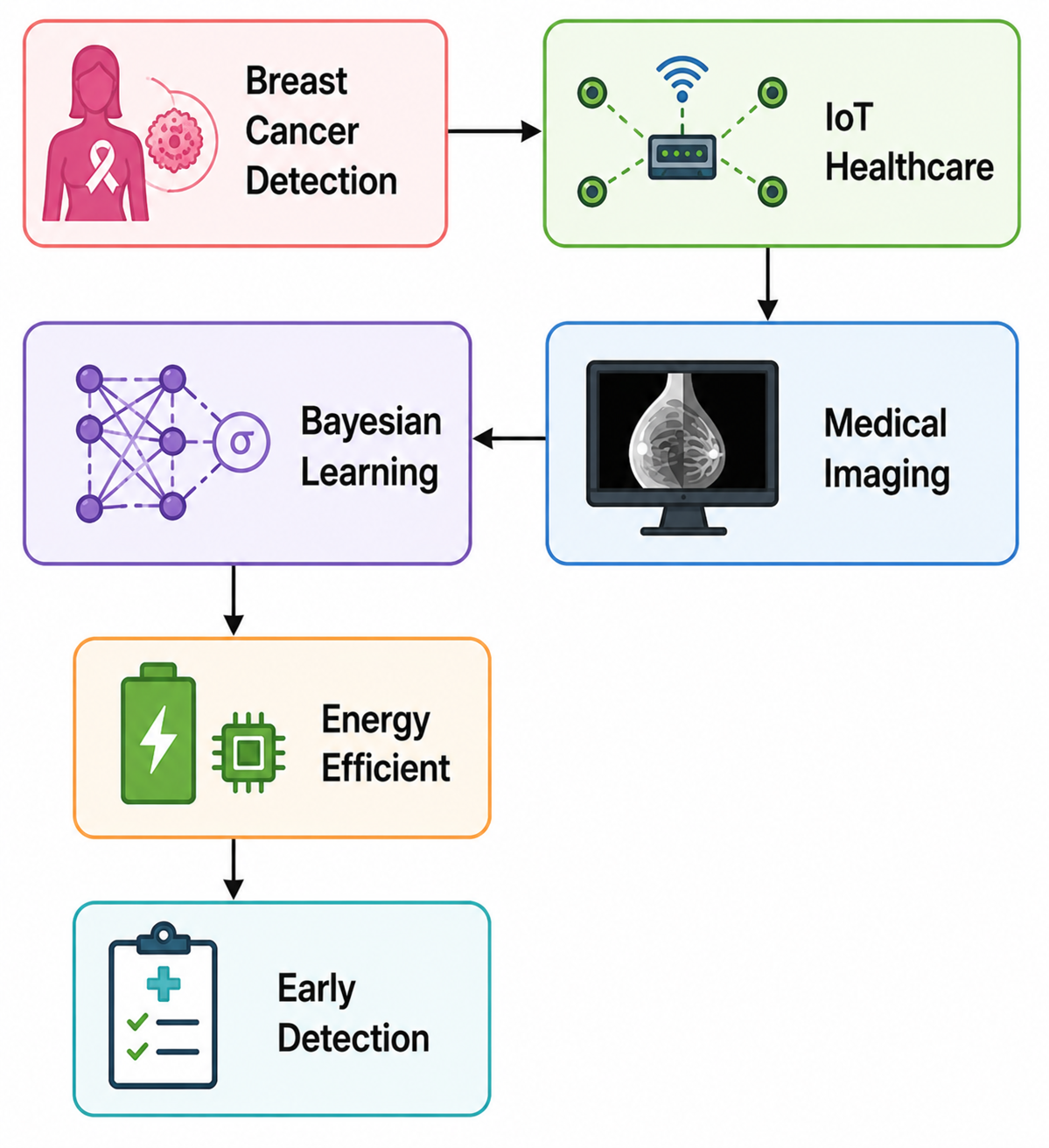
Breast cancer remains one of the leading causes of mortality among women worldwide, making early detection and accurate diagnosis essential for improving survival and treatment outcomes. Recent advances in the Internet of Things (IoT), Wireless Sensor Networks (WSNs), and Artificial Intelligence (AI) have transformed healthcare by enabling continuous monitoring, remote diagnostics, and intelligent medical image analysis. However, challenges related to energy consumption, computational complexity, data security, and prediction uncertainty continue to limit the effectiveness of IoT-enabled diagnostic systems. Bayesian Neural Networks (BNNs) have emerged as a reliable approach for uncertainty-aware learning by providing confidence estimates that support clinical decision-making and reduce false diagnoses. Furthermore, quantized neural networks minimize computational requirements and energy consumption, making them suitable for deployment on resource-constrained IoT and WSN devices. Deep learning models, particularly Convolutional Neural Networks (CNNs), have demonstrated high accuracy in analysing mammography, MRI, and ultrasound images for breast cancer detection. This review comprehensively examines recent developments in Bayesian quantized neural networks and energy-efficient WSN architectures for IoT-based breast cancer diagnosis, compares existing methodologies, identifies research challenges, and outlines future directions for developing reliable, scalable, and intelligent healthcare systems with enhanced diagnostic performance.