
Digital Twin-Assisted Explainable Graph Neural Networks for Intelligent Monitoring and Predictive Maintenance of Smart Electrical Grids
DOI:
https://doi.org/10.65521/itsi-teee.v15i2.3875Keywords:
Abstract
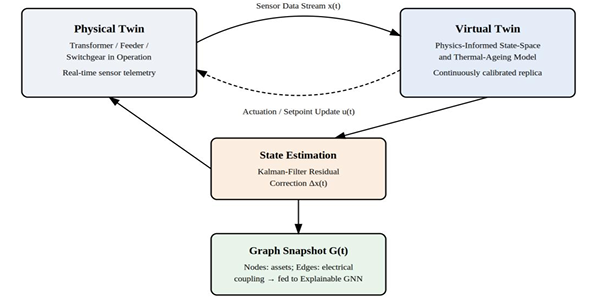
Aging transformers, feeders, and switchgear, combined with rising penetration of distributed renewable generation, are exposing the limits of calendar-based and threshold-triggered maintenance in modern power networks. This paper proposes a Digital Twin-Assisted Explainable Graph Neural Network (DT-XGNN) framework for intelligent condition monitoring and predictive maintenance of smart electrical grids. A physics-informed digital twin, continuously synchronized with IoT sensor telemetry through Kalman-filter state correction, produces a time-indexed graph representation of the network in which nodes correspond to electrical assets and edges encode their physical coupling. A spatio-temporal graph attention network then estimates fault probability and remaining useful life (RUL) for every monitored asset, while a post-hoc explainability module, combining GNNExplainer-style edge masking with Integrated Gradients feature attribution, generates human-readable justifications for every maintenance alert. On a simulated IEEE 118-bus distribution testbed augmented with synthetic sensor telemetry and transformer thermal-ageing dynamics, the proposed framework achieves a fault-classification F1-score of 0.943 and an RUL root-mean-square error of 4.8% of asset lifetime, improving on non-graph and non-explainable baselines while providing per-alert attribution that field engineers can audit before dispatching a maintenance crew. The framework is presented as a decision-support layer for electrical and electronics engineering practice rather than a replacement for protection and SCADA systems, and its ablation study isolates the individual contribution of the digital twin features, the attention mechanism, and the explainability regularizer to overall performance.
Downloads
Published
How to Cite
Issue
Section
License

This work is licensed under a Creative Commons Attribution-NoDerivatives 4.0 International License.
