Design and Performance Analysis of a Solar-Powered Vapor Compression Refrigeration System
DOI:
https://doi.org/10.65521/ijtarme.v11i1.4438Keywords:
Abstract
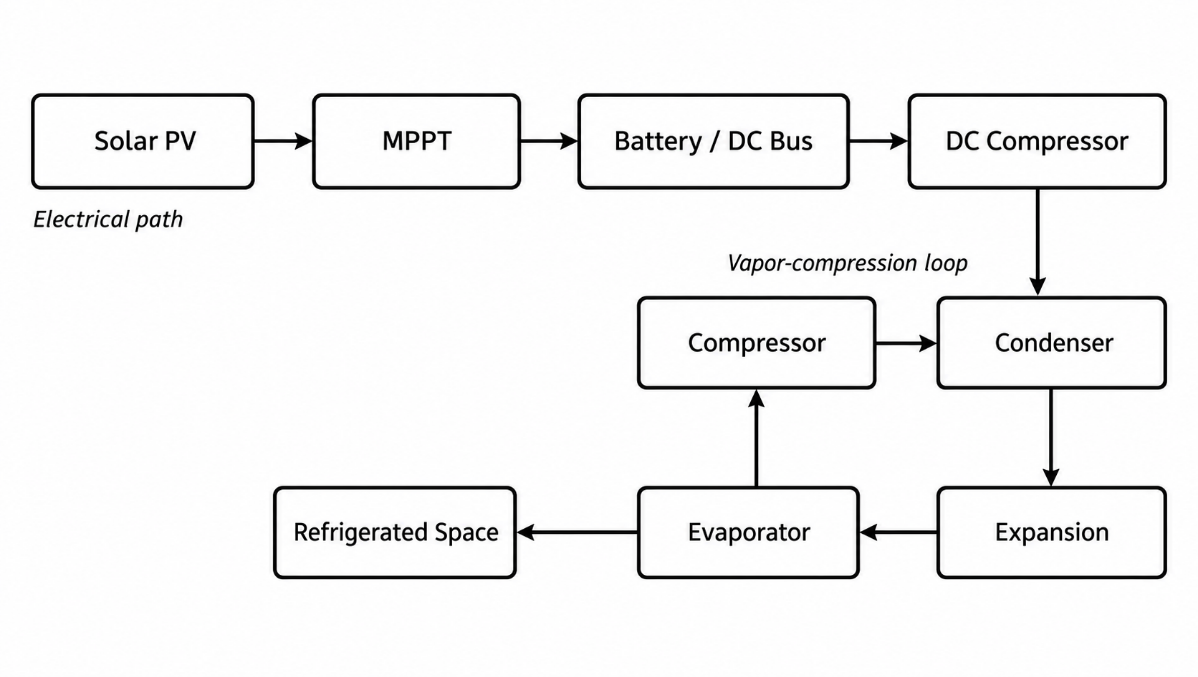
This paper presents a design-oriented methodology and performance analysis for a stand-alone solar-powered vapor compression refrigeration (PV-VCR) system intended for small cold-storage and food-preservation applications. The proposed configuration integrates a 400 Wp photovoltaic array, a maximum-power-point-tracking (MPPT) charge controller, a 24 V battery/DC bus, a variable-speed brushless-DC compressor, and a conventional vapor-compression loop using a low-charge hydrocarbon refrigerant. The study combines cooling-load estimation, photovoltaic and battery sizing, steady-state refrigeration-cycle analysis, and sensitivity evaluation with respect to solar irradiance and ambient temperature. A 150 L refrigerated cabinet maintained at 4 °C is used as the design case. The calculated peak cooling requirement is approximately 230 W and the estimated daily electrical demand is 1.28 kWh. Under a representative solar resource of 5.5 kWh/m²/day, the 400 Wp array can supply about 1.72 kWh/day after system losses, enabling full solar coverage on a clear design day and providing charging margin for the battery. The modeled refrigeration coefficient of performance (COP) varies from approximately 2.37 at low compressor speed to 2.07 at high solar input, while increasing ambient temperature from 25 to 40 °C reduces COP from 2.55 to 1.96. These results agree with the performance trends reported for directly coupled and PV-driven refrigeration systems in the literature. The proposed methodology demonstrates that careful matching of the photovoltaic generator, compressor, energy storage, and thermal load can provide reliable refrigeration with reduced dependence on grid electricity in sunny and remote locations.