
Supply Chain Resilience and Risk Management Practices In Small and Medium Enterprises
DOI:
https://doi.org/10.65521/ijrdmr.v10i1.4559Keywords:
Abstract
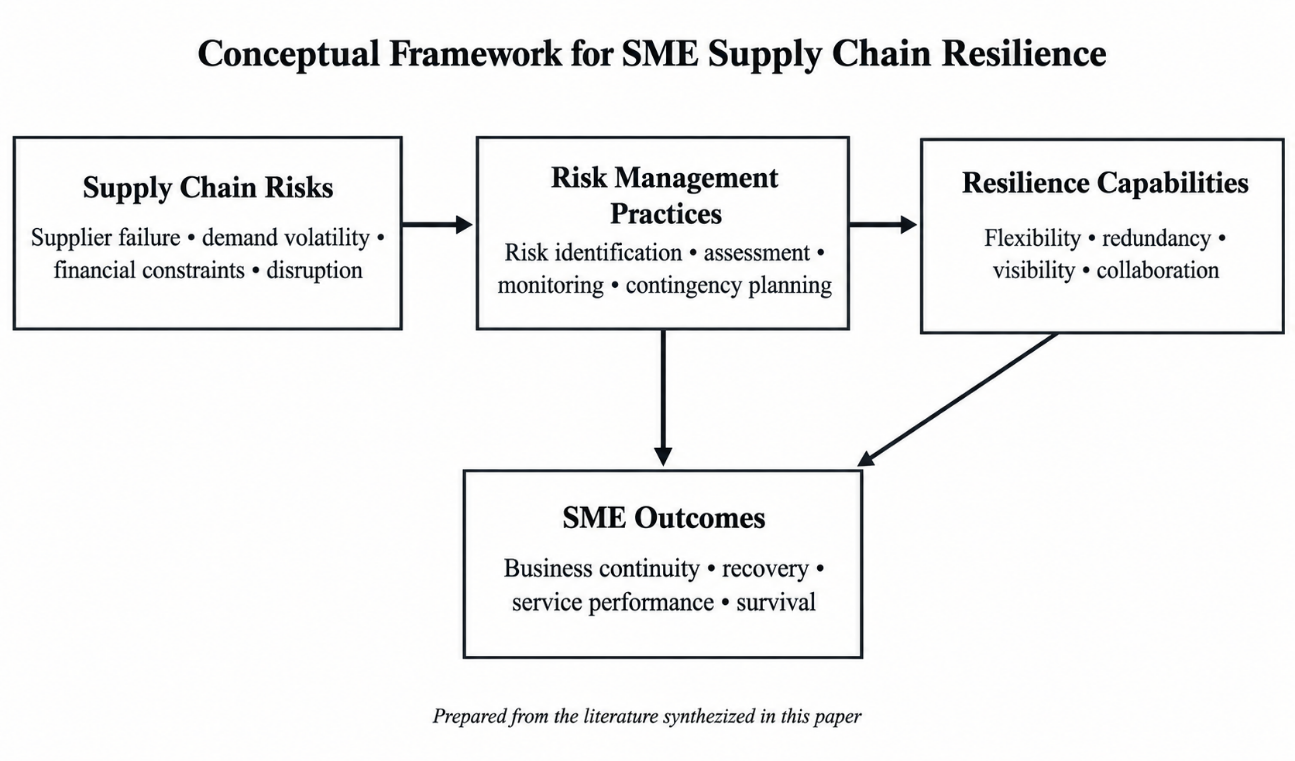
Small and medium enterprises (SMEs) operate with comparatively limited financial, technological, human and managerial resources, which can increase their exposure to supply interruptions and reduce their ability to absorb shocks. This paper examines supply chain resilience and risk management practices in SMEs through a structured review of academic literature published up to 2021. The study synthesizes evidence on major supply chain risks, risk-management practices, resilience capabilities and organizational outcomes. The methodology combines database-oriented literature identification, eligibility screening, thematic coding and comparative synthesis. The reviewed literature indicates that supplier dependence, demand uncertainty, financial constraints, inadequate information visibility, transportation disruption and limited contingency planning are recurring concerns. Practices such as risk identification and monitoring, supplier diversification, information sharing, collaboration, flexible sourcing, inventory buffers and business-continuity planning are frequently associated with stronger resilience. SME-specific research also emphasizes the importance of organizational capabilities, information systems, collaboration and access to finance. The paper develops a concise conceptual framework linking supply chain risk, risk-management practices, resilience capabilities and SME outcomes. The findings provide a basis for future empirical studies of SMEs in emerging and developed economies.
Downloads
Downloads
Published
How to Cite
Issue
Section
License

This work is licensed under a Creative Commons Attribution-NoDerivatives 4.0 International License.
