
Reconceptualizing Leadership in the Artificial Intelligence Era: Digital Competence, Employee Adaptability, and Organizational Transformation
DOI:
https://doi.org/10.65521/ijrdmr.v8i1.4406Keywords:
Abstract
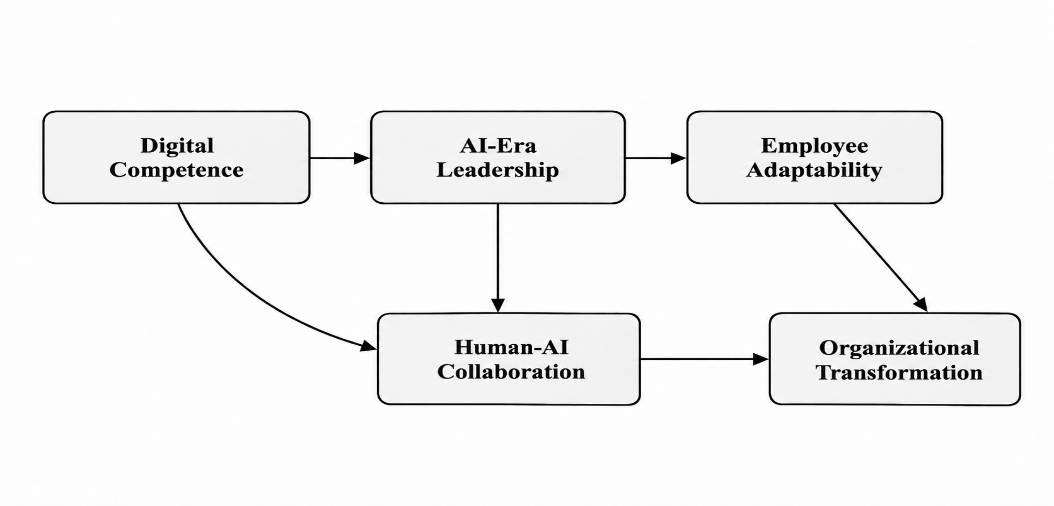
Artificial intelligence (AI) is altering the information, coordination, and decision environments in which leadership is practiced. This methodology paper reconceptualizes leadership in the AI era as an integrative organizational capability that combines digital competence, human–AI judgment, employee adaptability, and transformation-oriented governance. Rather than treating leadership as a stable set of interpersonal traits, the paper develops a research framework in which leaders’ sense technological opportunities, interpret algorithmic outputs, mobilize employees, and reconfigure structures and routines. The study uses an integrative conceptual methodology based exclusively on scholarly literature published up to and including 2020. The synthesis draws on e-leadership, transformational leadership, digital transformation, dynamic capabilities, AI-supported decision making, digital skills, and adaptive performance research. A structured construct-mapping procedure is proposed to translate these streams into a testable model. The resulting framework positions digital competence as a foundational leadership resource, employee adaptability as a critical behavioral mechanism, human–AI collaboration as a decision-process mechanism, and organizational transformation as the principal outcome. The paper further specifies propositions, operational definitions, measurement suggestions, and an empirical validation pathway using survey data and structural equation modeling. The conceptual results suggest that AI-era leadership should be evaluated not by technology adoption alone but by its capacity to create trustworthy augmentation, learning agility, strategic renewal, and coordinated change. The framework offers a methodologically explicit foundation for future empirical studies of leadership under AI-enabled organizational conditions.
Downloads
Downloads
Published
How to Cite
Issue
Section
License

This work is licensed under a Creative Commons Attribution-NoDerivatives 4.0 International License.
