
Customer Satisfaction and Service Quality in Public Sector Banks: An Empirical Analysis
DOI:
https://doi.org/10.65521/ijrdmr.v4i1.4305Keywords:
Abstract
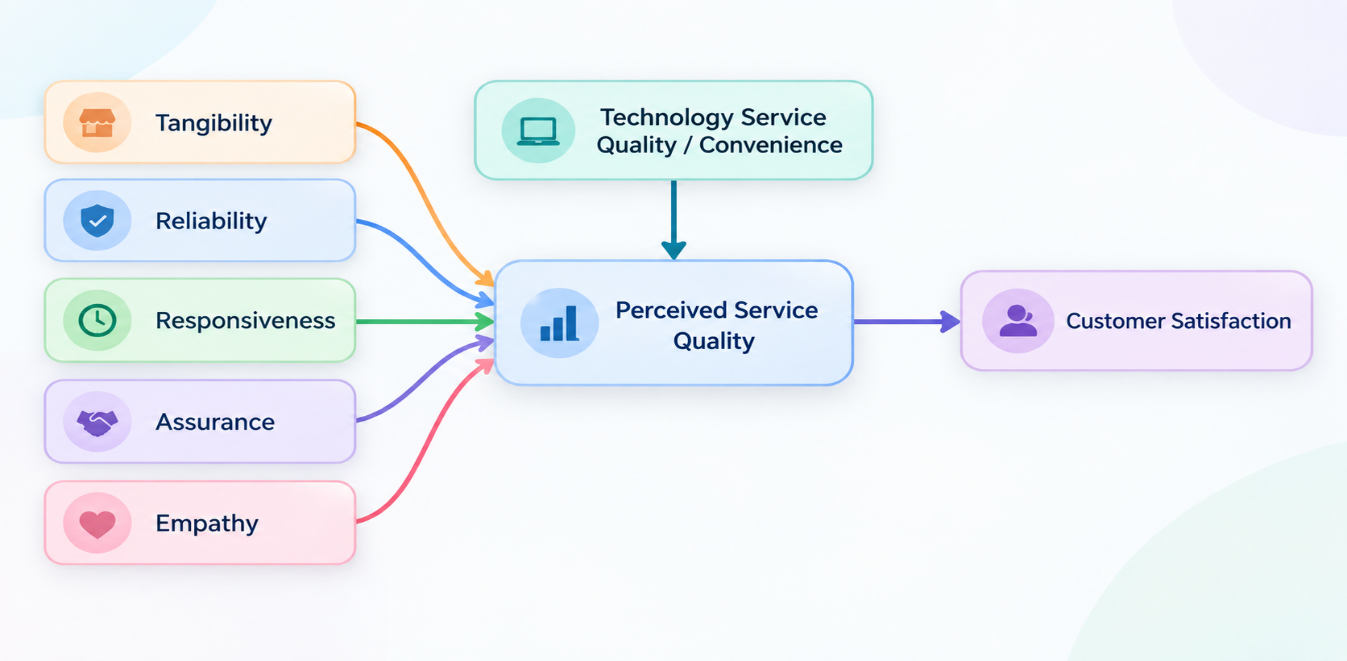
Customer satisfaction has become a central performance indicator for public sector banks because customers increasingly evaluate banks not only by financial safety and branch availability but also by speed, reliability, employee behaviour, problem resolution and technology-enabled convenience. This methodology paper develops an empirical framework for examining the relationship between perceived service quality and customer satisfaction in public sector banks. The proposed model combines the traditional service-quality dimensions of tangibility, reliability, responsiveness, assurance and empathy with technology-service quality and convenience, reflecting the changing retail-banking environment. The study proposes a quantitative, cross-sectional survey of active customers of selected public sector banks, using a structured questionnaire and five-point Likert scales. Established evidence shows that service quality precedes customer satisfaction, bank-specific dimensions such as access, reliability and assurance require context-sensitive measurement, and Indian retail-banking research confirms the importance of human behaviour, convenience and technology in customer evaluations. Reliability analysis, exploratory factor analysis, correlation and multiple regression are proposed, with structural equation modelling as an optional extension. As no primary survey dataset is supplied, the Results section presents expected or illustrative findings rather than invented empirical results. The methodology offers a replicable approach for identifying the service dimensions that public sector banks should prioritize to improve customer satisfaction and strengthen customer relationships.
Downloads
Downloads
Published
How to Cite
Issue
Section
License

This work is licensed under a Creative Commons Attribution-NoDerivatives 4.0 International License.
