
Impact of Employee Engagement on Organizational Performance: A Study of Indian Service Sector Companies
DOI:
https://doi.org/10.65521/ijrdmr.v4i1.4304Keywords:
Abstract
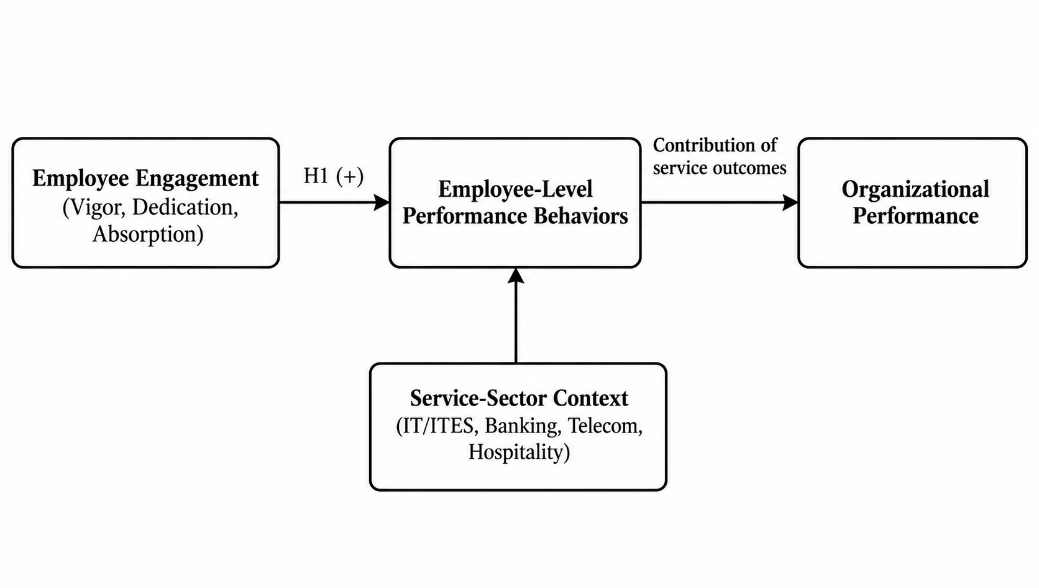
Employee engagement has become a central human resource concern because service organizations depend heavily on the discretionary effort, emotional investment, and customer-oriented behavior of employees. This methodology paper develops a research design for examining the impact of employee engagement on organizational performance in Indian service-sector companies. Drawing on Kahn’s engagement theory, the job demands-resources perspective, social exchange theory, and empirical evidence linking engagement with individual and business-unit outcomes, the study proposes a cross-sectional explanatory survey of employees working in IT/ITES, banking and financial services, telecommunications, and hospitality. Employee engagement is operationalized through vigor, dedication, and absorption, while organizational performance is assessed using employee perceptions of productivity, service quality, customer responsiveness, goal attainment, and innovation. A stratified sampling approach, structured questionnaire, reliability analysis, correlation, and multiple regression are recommended. To demonstrate how the design would be interpreted, the paper reports an explicitly illustrative synthetic results set in which engagement is positively associated with organizational performance. The framework is intended to support a rigorous empirical study in the Indian service context while avoiding causal claims that cannot be justified by cross-sectional data.
Downloads
Downloads
Published
How to Cite
Issue
Section
License

This work is licensed under a Creative Commons Attribution-NoDerivatives 4.0 International License.
