
A Study on Consumer Buying Behaviour Towards Online Shopping in India
DOI:
https://doi.org/10.65521/ijrdmr.v4i1.4303Keywords:
Abstract
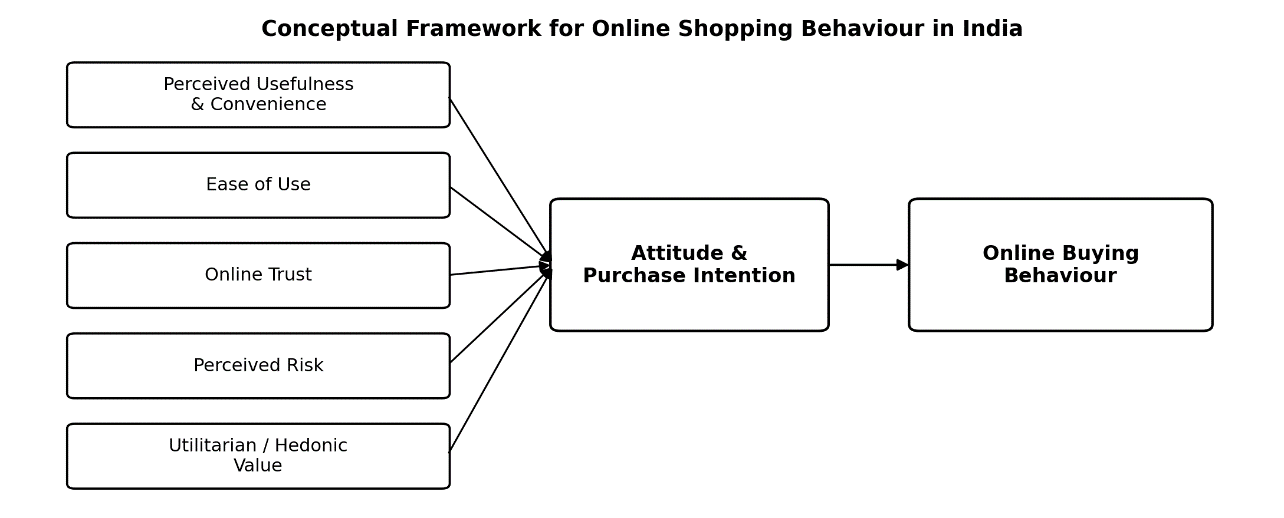
The expansion of online retailing has transformed the buying process by allowing consumers to compare alternatives, obtain information, evaluate prices and complete transactions without visiting physical stores. In India, however, online buying behaviour is shaped not only by convenience and technology acceptance but also by trust, perceived risk, value orientation, prior experience and the social context in which digital commerce is used. This methodology paper develops an empirical framework for examining the factors that influence consumer buying behaviour toward online shopping in India. A quantitative, cross-sectional survey design is proposed with adult Indian consumers who have purchased at least one product online during the preceding six months. The model integrates perceived usefulness and convenience, ease of use, online trust, perceived risk, utilitarian and hedonic value, and prior online shopping experience as predictors of attitude, purchase intention and buying behaviour. Data are proposed to be collected through a structured five-point Likert-scale questionnaire and analysed using descriptive statistics, reliability analysis, Pearson correlation and multiple regression. The methodology is informed by established e-commerce research and India-specific studies published no later than 2015. An illustrative results section demonstrates how findings may be reported without representing synthetic values as actual field evidence. The proposed approach offers a replicable basis for assessing how Indian consumers evaluate online retail channels and how e-retailers can improve trust, usability, perceived value and purchase conversion.
Downloads
Downloads
Published
How to Cite
Issue
Section
License

This work is licensed under a Creative Commons Attribution-NoDerivatives 4.0 International License.
