
A Study of Consumer Buying Behaviour in the Indian Retail Sector
DOI:
https://doi.org/10.65521/ijrdmr.v5i1.4298Keywords:
Abstract
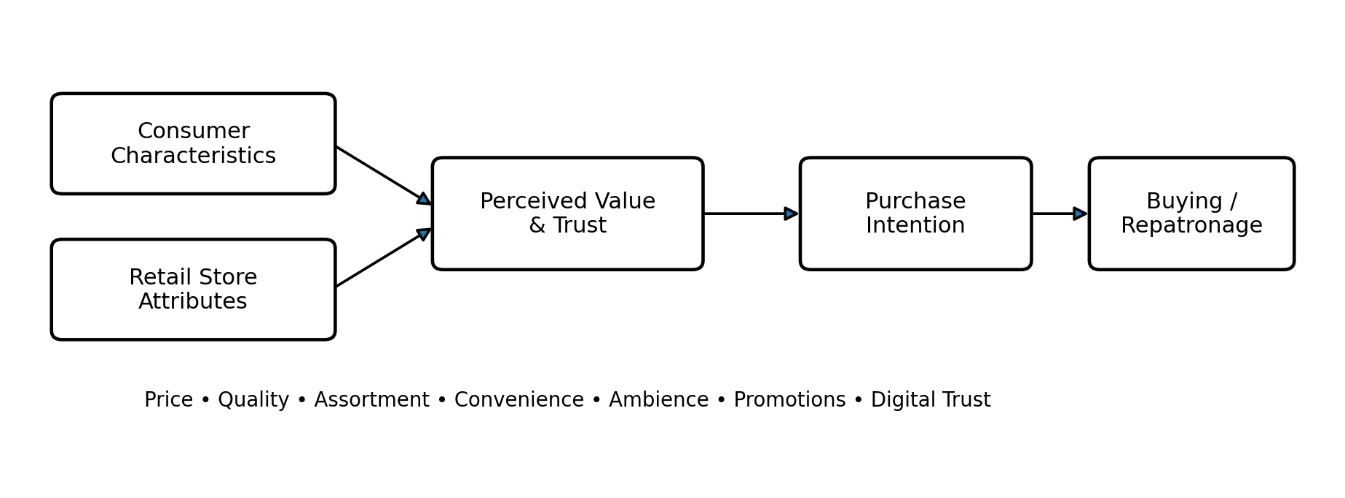
The Indian retail sector has undergone a marked transition from predominantly traditional neighborhood stores to a mixed structure that includes supermarkets, department stores, shopping malls, specialty outlets and rapidly expanding e-retail channels. This study develops a compact empirical framework for examining consumer buying behaviour in this changing environment. It focuses on the effects of price consciousness, perceived product quality, assortment, convenience, store ambience, promotional attractiveness, retailer trust and demographic characteristics on purchase intention and repeat patronage. Prior Indian research shows that location and assortment influence category-specific shopping, mall patronage is shaped by demographic and psychographic differences, relationship quality affects store-format choice, and retailer awareness, perceived quality and self-congruity contribute to purchase intention and loyalty (Kuruvilla & Joshi, 2010; Chattopadhyay, 2013; Tripathi & Dave, 2013; Das, 2014a, 2014b). A structured questionnaire and multivariate analysis are proposed for field implementation. To demonstrate the analytical procedure without presenting invented field evidence as fact, the Results section uses an explicitly illustrative dataset of 300 hypothetical respondents. The demonstration suggests that product quality, price/value, convenience and trust would be expected to emerge as the strongest predictors of purchase intention, while age may influence retail-format preference. The paper offers a practical research design for retailers and researchers interested in consumer segmentation, store positioning and integrated offline-online retail strategy in India.
Downloads
Downloads
Published
How to Cite
Issue
Section
License

This work is licensed under a Creative Commons Attribution-NoDerivatives 4.0 International License.
