
Corporate Social Responsibility and Its Impact on Organizational Reputation
DOI:
https://doi.org/10.65521/ijrdmr.v5i1.4297Keywords:
Abstract
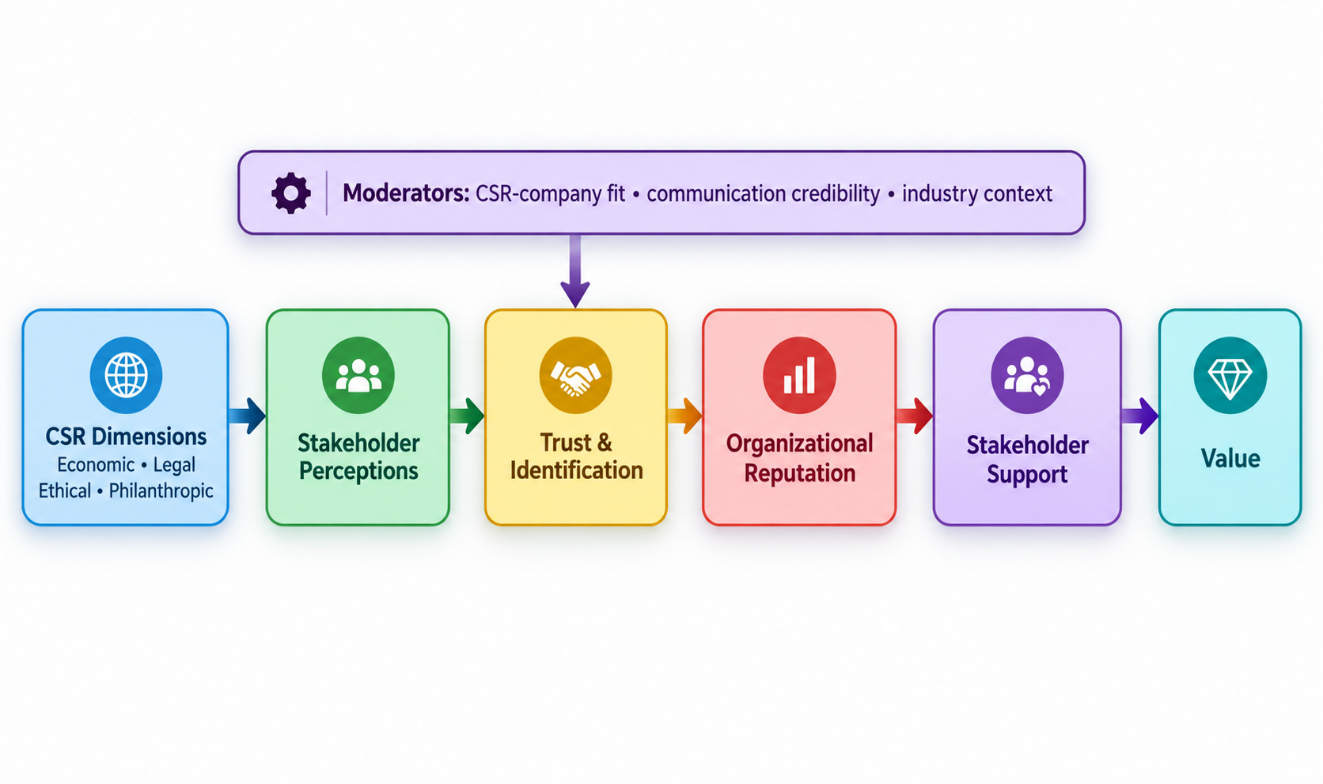
Corporate social responsibility (CSR) has moved from a peripheral philanthropic activity to a strategic organizational practice that influences how stakeholders evaluate firms. This methodology-oriented paper examines the relationship between CSR and organizational reputation using a structured synthesis of research published up to and including 2016 and proposes an empirical framework for future testing. The study conceptualizes CSR through economic, legal, ethical and philanthropic responsibilities and treats organizational reputation as a stakeholder-based cumulative evaluation of organizational credibility, trustworthiness and social standing. A quantitative, cross-sectional design is proposed in which data are collected from employees and customers through a structured questionnaire and analyzed using reliability tests, correlation, multiple regression and, where sample size permits, structural equation modelling. The literature consistently indicates that CSR can strengthen reputation when stakeholders perceive the activities as authentic, relevant and consistent with organizational identity. Trust, corporate identification, communication credibility and CSR-company fit are identified as important mechanisms shaping the relationship. Because the present paper is methodological rather than a report of newly collected field data, the results section synthesizes established pre-2017 empirical patterns and specifies the expected direction of hypotheses without fabricating original statistical outcomes. The paper concludes that CSR is most likely to create reputational value when it is integrated into core strategy, communicated credibly and aligned with stakeholder expectations.
Downloads
Downloads
Published
How to Cite
Issue
Section
License

This work is licensed under a Creative Commons Attribution-NoDerivatives 4.0 International License.
