
Financial Performance Evaluation of Public and Private Sector Banks in India
DOI:
https://doi.org/10.65521/ijrdmr.v5i1.4296Keywords:
Abstract
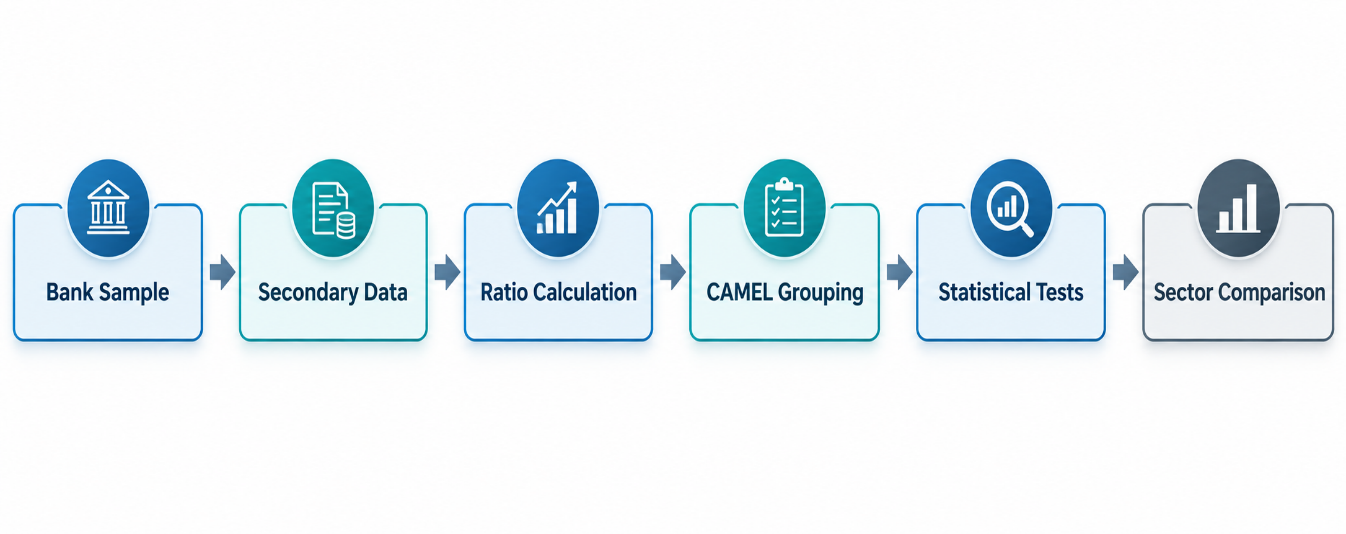
This methodology paper develops a structured framework for evaluating and comparing the financial performance of public and private sector banks in India using accounting ratios, ownership-based comparison, and efficiency-oriented interpretation. The proposed design combines capital adequacy, asset quality, management efficiency, earnings, and liquidity indicators within a CAMEL-style framework and supplements ratio analysis with descriptive statistics, tests of group differences, and optional efficiency analysis. The approach is intended for secondary financial data over a consistent five-year window ending in 2016, thereby keeping the reference base within the requested period. Earlier Indian banking studies show that ownership effects are not uniform: public banks have sometimes displayed strong technical efficiency, whereas private banks have often shown advantages in profitability, soundness, and market-oriented performance. The paper therefore avoids treating ownership as a predetermined indicator of superiority. Instead, it proposes a transparent, replicable procedure in which each dimension is evaluated separately before a composite interpretation is made. A literature-grounded demonstration indicates that private banks are generally expected to lead on profitability and asset-quality indicators, while public banks may remain competitive in scale, intermediation, and selected efficiency measures. The framework can support researchers, bank managers, regulators, and students who require a concise but rigorous method for comparing bank performance without relying on a single financial ratio.
Downloads
Downloads
Published
How to Cite
Issue
Section
License

This work is licensed under a Creative Commons Attribution-NoDerivatives 4.0 International License.
