
Role of Leadership Style in Enhancing Employee Productivity
DOI:
https://doi.org/10.65521/ijrdmr.v6i1.4294Keywords:
Abstract
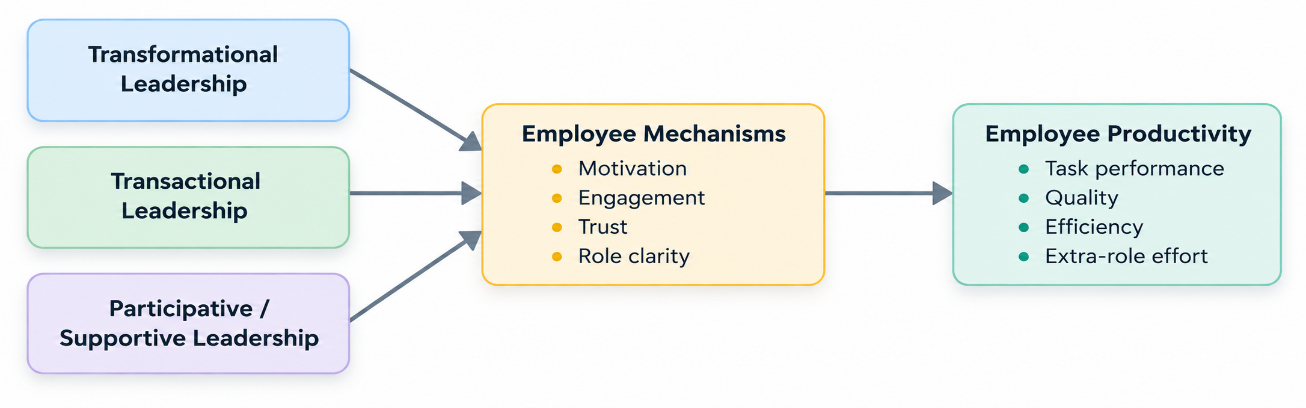
Leadership style is a central managerial factor shaping employee effort, motivation, engagement, role clarity, and work performance. This study examines the role of leadership style in enhancing employee productivity by synthesizing established empirical evidence published up to 2016. The paper focuses primarily on transformational, transactional, participative/supportive, and passive leadership patterns and evaluates the mechanisms through which they affect individual and team outcomes. A structured literature-based methodology was used, giving priority to peer-reviewed studies and meta-analyses with verified Digital Object Identifiers (DOIs). The evidence indicates that transformational leadership has the most consistently positive association with employee productivity because it strengthens meaningfulness, trust, intrinsic motivation, engagement, and willingness to exert extra effort. Transactional leadership, especially contingent reward, is also effective when performance goals are clear and rewards are perceived as fair. Participative and supportive behaviours improve ownership and information sharing, whereas passive or laissez-faire leadership generally provides weak performance support. The synthesis further shows that leadership does not influence productivity through a single direct route; its effects are transmitted through psychological and job-related mechanisms such as engagement, job characteristics, satisfaction, and leader-follower trust. The study concludes that organizations should develop leaders who combine inspirational direction with clear expectations, feedback, fair rewards, and employee involvement.
Downloads
Downloads
Published
How to Cite
Issue
Section
License

This work is licensed under a Creative Commons Attribution-NoDerivatives 4.0 International License.
