
Impact of Employee Training and Development on Organizational Performance
DOI:
https://doi.org/10.65521/ijrdmr.v6i1.4293Keywords:
Abstract
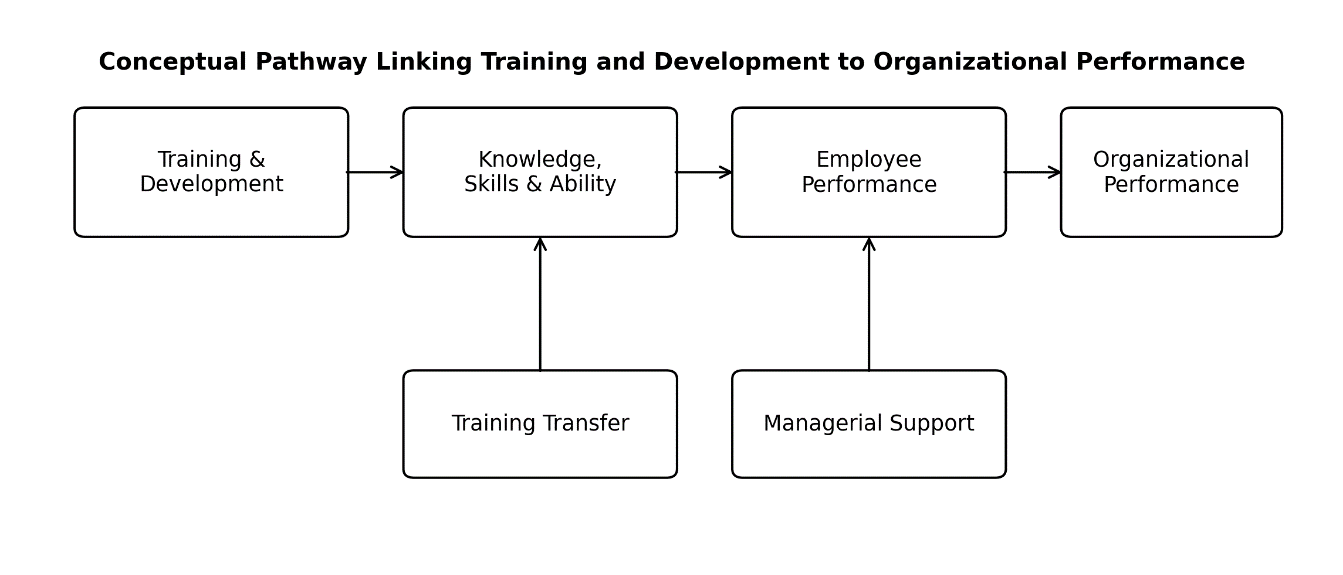
Employee training and development is a central human resource practice through which organizations build job-related knowledge, skills, attitudes, adaptability, and future capabilities. This paper examines how training and development influence organizational performance by integrating evidence published up to 2019. A structured literature-based methodology is used to connect training inputs with learning, transfer to the workplace, employee performance, productivity, innovation, and firm-level outcomes. The reviewed evidence indicates that well-designed training generally improves learning and behavioral performance, but organizational benefits depend strongly on transfer conditions, managerial support, alignment with strategic needs, and evaluation. Meta-analytic evidence shows medium-to-large effects of training on learning, behavior, and results, while firm-level research links internal training with productivity, innovation, and financial performance. The synthesis further shows that training alone is insufficient: organizations obtain stronger returns when programs are needs-based, practice-oriented, supported after training, and integrated with broader human resource systems. A conceptual framework is proposed in which training and development enhance employee capability, which improves employee performance and subsequently contributes to organizational outcomes. Training transfer and managerial support act as key enabling mechanisms. The paper concludes that training and development should be treated as a strategic investment and measured at multiple levels rather than as an isolated administrative activity.
Downloads
Downloads
Published
How to Cite
Issue
Section
License

This work is licensed under a Creative Commons Attribution-NoDerivatives 4.0 International License.
