
Strategic Management Practices and Business Growth of Small and Medium Enterprises
DOI:
https://doi.org/10.65521/ijrdmr.v6i1.4291Keywords:
Abstract
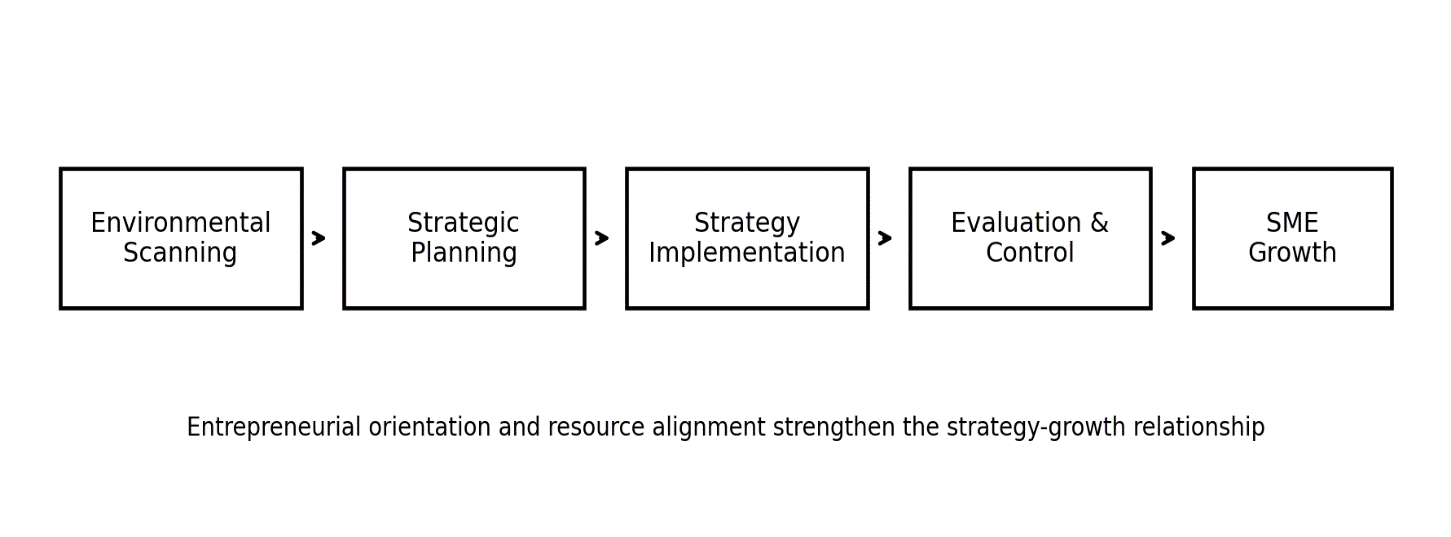
Small and medium enterprises (SMEs) depend heavily on managerial judgment because they usually operate with constrained finance, limited specialized staff, and high exposure to market uncertainty. This study examines how strategic management practices influence business growth in SMEs by integrating environmental scanning, formal strategic planning, strategy implementation, evaluation and control, entrepreneurial orientation, and resource alignment into a single analytical framework. A quantitative, cross-sectional methodology is proposed for owner-managers and senior managers of SMEs. The model measures strategic management practices through multi-item Likert scales and evaluates business growth using sales growth, customer growth, market expansion, employment growth, and perceived profitability. The literature indicates that planning is most valuable when it is accompanied by implementation discipline, learning, and adaptation rather than treated as a static document. The proposed results framework therefore tests both direct relationships and the combined contribution of strategic practices to SME growth. Illustrative statistical results demonstrate how reliability analysis, correlation, and multiple regression may be reported in a complete empirical paper. The framework contributes a practical method for diagnosing strategic weaknesses in SMEs and provides managers with a structured path from environmental analysis to measurable growth. For publication or thesis submission, the illustrative results should be replaced with data obtained from the selected SME sample.
Downloads
Downloads
Published
How to Cite
Issue
Section
License

This work is licensed under a Creative Commons Attribution-NoDerivatives 4.0 International License.
